Geometric Characteristics of Tungsten Carbide Drill BitⅠ
- Category: Tungsten Information
- Published on 19 November 2015

Drill bits are usually connected to a mechanism, often simply referred to as a drill, which rotates them and provides torque and axial force to create the hole.
Tungsten carbide drill bits are cutting tools used to create cylindrical holes, almost always of circular cross-section. Exceptionally, specially shaped bits can cut holes of non-circular cross-section. Tungsten carbide drill bit can drill virtually all materials while holding an edge longer than other bits. The carbide material is expensive and much more brittle than steels; consequently they are mainly used for drill bit tips, small pieces of hard material fixed or brazed onto the tip of a bit made of less hard metal. However, it is becoming common in job shops to use solid carbide bits. In very small sizes it is difficult to fit carbide tips; in some industries, most notably PCB manufacturing, requiring many holes with diameters less than 1 mm, solid carbide bits are used.
Tungsten carbide drill bits come in many sizes and have many uses. The shank is the part of the drill bit grasped by the chuck of a drill. The cutting edges of the drill bit are at one end, and the shank is at the other.
(To be continued. This article is divided into several parts. Here is part 1. For part 2, please refer to http://news.chinatungsten.com/en/tungsten-information/80547-ti-10417)
| Tungsten Carbide Supplier: Chinatungsten Online tungsten-carbide.com.cn |
Tel.: 86 592 5129696; Fax: 86 592 5129797;Email: |
| Tungsten News&Tungsten Prices, 3G Version: http://3g.chinatungsten.com | Molybdenum News & Molybdenum Price: http://news.molybdenum.com.cn |
Crystallisation and Processing of Ammonium Paratungstate (APT)
- Category: Tungsten Information
- Published on 19 November 2015
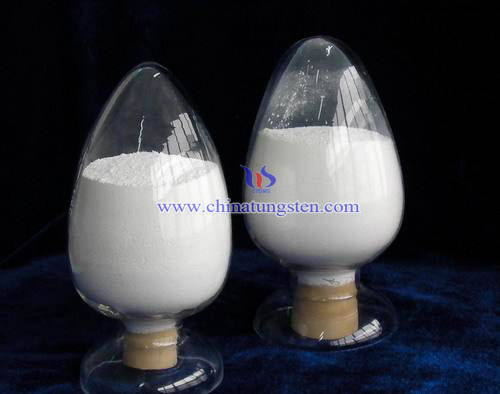
Crystallisation and processing of ammonium paratungstate (APT)
Ammonium paratungstate (or APT) is a white crystalline salt of ammonium and tungsten, with the chemical formula (NH4)10(H2W12O42)·4H2O.
Ammonium paratungstate is produced by separating tungsten from its ore. Once the ammonium paratungstate is prepared, it is heated to its decomposition temperature, 600 °C. Left over is WO3, tungsten(VI) oxide. From there, the oxide is heated in an atmosphere of hydrogen, reducing the tungsten to elemental powder, leaving behind water vapor. From there, the tungsten powder can be fused into any number of things, from wire to bars to other shapes.
This paper starts with the chemistry of tungsten in aqueous solutions. Various aspects of the crystallisation of the hydrates of ammonium paratungstate (APT) will be discussed in addition. This is then followed by the chemistry of the first pyrometallurgical treatment in non-sag (NS) tungsten manufacturing, the processing of APT into tungsten blue oxide. The section is mainly devoted to the chemistry of the thermal decomposition of APT in various atmospheres. Finally, parameters controlling tungsten blue oxide quality will be discussed.
| Tungsten Supplier: Chinatungsten Online www.chinatungsten.com |
Tel.: 86 592 5129696; Fax: 86 592 5129797;Email: |
| Tungsten News & Prices, 3G Version: http://3g.chinatungsten.com | Molybdenum News & Molybdenum Price: http://news.molybdenum.com.cn |
Plasma Synthesis of Tungsten Carbide Nanopowder from Ammonium Paratungstate
- Category: Tungsten Information
- Published on 19 November 2015
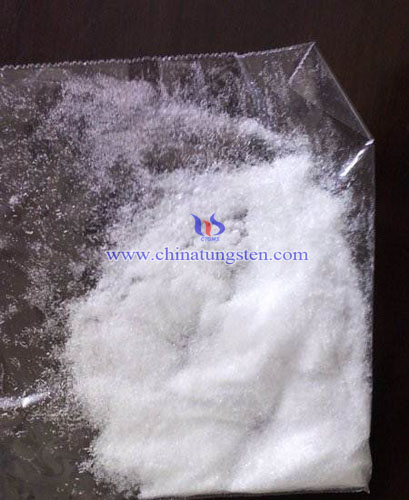
Ammonium paratungstate (or APT) is a white crystalline salt of ammonium and tungsten, with the chemical formula (NH4)10(H2W12O42)·4H2O.
Ammonium paratungstate is produced by separating tungsten from its ore. Once the ammonium paratungstate is prepared, it is heated to its decomposition temperature, 600 °C. Left over is WO3, tungsten(VI) oxide. From there, the oxide is heated in an atmosphere of hydrogen, reducing the tungsten to elemental powder, leaving behind water vapor. From there, the tungsten powder can be fused into any number of things, from wire to bars to other shapes.
A thermal plasma process has been applied to the synthesis of nanosized tungsten carbide powder with ammonium paratungstate (APT) as the precursor. The reduction and carburization of vaporized APT produced nanosized tungsten carbide (WC1−x) powder, which sometimes contained a small amount of W2C phase. The effects of reactant gas composition, plasma torch power, the flow rate of plasma gas, and the addition of secondary plasma gas (H2) on the product composition and particle size were investigated. The produced tungsten carbide (WC1−x) powder was <20 nm in particle size. The synthesized powders were also subjected to a hydrogen heat treatment to fully carburize the WC1−x and W2C phases to the WC phase as well as to remove excess carbon. Finally, WC powder of particle size <100 nm was obtained.
| Tungsten Supplier: Chinatungsten Online www.chinatungsten.com |
Tel.: 86 592 5129696; Fax: 86 592 5129797;Email: |
| Tungsten News & Prices, 3G Version: http://3g.chinatungsten.com | Molybdenum News & Molybdenum Price: http://news.molybdenum.com.cn |
Characterization of Various Commercial Forms of Ammonium Paratungstate Powder
- Category: Tungsten Information
- Published on 19 November 2015
Characterization of various commercial forms of ammonium paratungstate powder
Ammonium paratungstate (or APT) is a white crystalline salt of ammonium and tungsten, with the chemical formula (NH4)10(H2W12O42)·4H2O.
Ammonium paratungstate is produced by separating tungsten from its ore. Once the ammonium paratungstate is prepared, it is heated to its decomposition temperature, 600 °C. Left over is WO3, tungsten(VI) oxide. From there, the oxide is heated in an atmosphere of hydrogen, reducing the tungsten to elemental powder, leaving behind water vapor. From there, the tungsten powder can be fused into any number of things, from wire to bars to other shapes.
The structures and morphologies of various commercial forms of ammonium paratungstate have been studied and related to the processes used for the production of this material. High temperature crystallization processes are shown to produce the monoclinic pentahydrate 5(NH4)2O.12WO3.5H2O which yields a cuboid or equiaxed monoclinic powder morphology. Crystallization at room temperature produces the orthorhombic undecahydrate 5(NH4)20.12WO3.11H2O which has a lath-like particle morphology. Freeze-dried ammonium paratungstate is shown to be amorphous in nature, to have a chemical composition approaching that of the undecahydrate, and to have a porous, multiparticulate agglomerate particle morphology. The apparent densities of the samples of ammonium paratungstate are explained in terms of the particle morphologies.
| Tungsten Supplier: Chinatungsten Online www.chinatungsten.com |
Tel.: 86 592 5129696; Fax: 86 592 5129797;Email: |
| Tungsten News & Prices, 3G Version: http://3g.chinatungsten.com | Molybdenum News & Molybdenum Price: http://news.molybdenum.com.cn |
The Thermal Decomposition of Ammonium Paratungstate
- Category: Tungsten Information
- Published on 18 November 2015
| Tungsten Supplier: Chinatungsten Online www.chinatungsten.com |
Tel.: 86 592 5129696; Fax: 86 592 5129797;Email: |
| Tungsten News & Prices, 3G Version: http://3g.chinatungsten.com | Molybdenum News & Molybdenum Price: http://news.molybdenum.com.cn |
Tungsten Carbide Step Drill bits Ⅴ
- Category: Tungsten Information
- Published on 18 November 2015
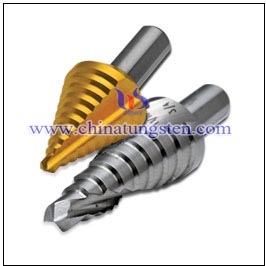
In last part we know that to start drilling with a smaller tungsten carbide step drill bit, it’s necessary to prepare a center mark on workpiece and apply cooling fluid. In this part we go on explain how to use a tungsten carbide step drill bit.
Step 5: release the chuck of the drill motor to remove the small tungsten carbide step drill bit. Secure the large step drill bit into the chuck of the drill motor. Insert the small tip of the large step drill bit into the hole you created in the metal. Apply cutting and tapping fluid onto the large step drill bit and around the hole in the metal.
Step 6: depress the trigger of the drill motor to run the large-diameter step drill bit into the hole. Stop drilling frequently to apply additional cutting and tapping fluid to the drill bit. Stop drilling when the hole has reached the desired diameter.
Step 7: remove the large tungsten carbide step drill bit from the drill motor. Clean both step drill bits with a rag to remove metal shavings from the bits. Clean the metal shavings from around the hole that you drilled in the metal. Store the drill bits in a tool box or drill bit container to avoid dropping them or otherwise damaging them.
(The end-This article is divided into 5 parts. Here is part 5. For part 4, please refer to http://news.chinatungsten.com/en/tungsten-information/80510-ti-10404)
| Tungsten Carbide Supplier: Chinatungsten Online tungsten-carbide.com.cn |
Tel.: 86 592 5129696; Fax: 86 592 5129797;Email: |
| Tungsten News&Tungsten Prices, 3G Version: http://3g.chinatungsten.com | Molybdenum News & Molybdenum Price: http://news.molybdenum.com.cn |
Tungsten Carbide Step Drill bits Ⅳ
- Category: Tungsten Information
- Published on 18 November 2015
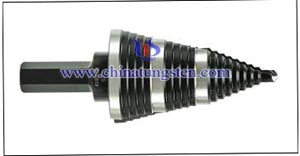
In last part we know that tungsten carbide step drill bits are also ideal for electrical work, such as chassis and front panels, and can be used to debur holes, but may at the same time cause bur on the a hole’s back side. In this part we talk about how to use a tungsten carbide step drill bit.
To use a tungsten carbide step drill bit, it is suggested to following the below steps.
Step 1: put on appropriate eye protection (safety glasses or goggles).
Step 2: place the tip of the center punch on the metal to be drilled at the location of the desired hole. Hit the blunt end of the center punch with the hammer to leave an indentation (referred to as a center mark). This indentation will provide a place for the tungsten carbide step drill bit to "catch", so it doesn't drift to the wrong location on the work.
Step 3: secure the self-starting step drill bit into the chuck of the drill motor. Apply cutting and tapping fluid to the center mark and the step drill bit.
Step 4: align the tip of the self-starting step drill bit with the center mark on the metal's surface. Depress the drill's trigger to start drilling the hole. Run the small step drill bit completely through the metal. Apply additional cutting and tapping fluid as necessary to keep the step drill bit cool.
(To be continued. This article is divided into 5 parts. Here is part 4. For part 3, please refer to http://news.chinatungsten.com/en/tungsten-information/80509-ti-10402; for part 5, please refer to http://news.chinatungsten.com/en/tungsten-information/80511-ti-10405)
| Tungsten Carbide Supplier: Chinatungsten Online tungsten-carbide.com.cn |
Tel.: 86 592 5129696; Fax: 86 592 5129797;Email: |
| Tungsten News&Tungsten Prices, 3G Version: http://3g.chinatungsten.com | Molybdenum News & Molybdenum Price: http://news.molybdenum.com.cn |
Tungsten Carbide Step Drill bits Ⅲ
- Category: Tungsten Information
- Published on 18 November 2015
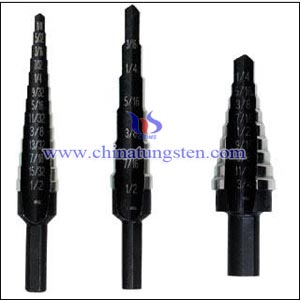
In last part we know that tungsten carbide step drill bits can drill an entire range of holes usually on softer material or sheet metal less than 1/4 inch thick. In this part we talk about the usage and advantage of this kind of bit.
Tungsten carbide step drill bits are ideal for use in electrical work where thin steel, aluminum or plastic boxes and chassis are encountered. The short length of the step drill bit and ability to vary the diameter of the finished hole is an advantage in chassis or front panel work. The finished hole can often be made quite smooth and burr-free, especially in plastic.
An additional use of tungsten carbide step drill bits is deburring holes left by other bits, as the sharp increase to the next step size allows the cutting edge to scrape burrs off the entry surface of the workpiece. However, the straight flute is poor at chip ejection, and can cause a burr to be formed on the exit side of the hole, more so than a spiral twist drill bit turning at high speed.
The step drill bit was invented by Harry C. Oakes and patented in 1973. It was sold only by the Unibit Corporation in the 1980s until the patent expired, and was later sold by other companies.
(To be continued. This article is divided into 5 parts. Here is part 3. For part 2, please refer to http://news.chinatungsten.com/en/tungsten-information/80508-ti-10401; for part 4, please refer to http://news.chinatungsten.com/en/tungsten-information/80510-ti-10404)
| Tungsten Carbide Supplier: Chinatungsten Online tungsten-carbide.com.cn |
Tel.: 86 592 5129696; Fax: 86 592 5129797;Email: |
| Tungsten News&Tungsten Prices, 3G Version: http://3g.chinatungsten.com | Molybdenum News & Molybdenum Price: http://news.molybdenum.com.cn |
Tungsten Carbide Step Drill bitsⅡ
- Category: Tungsten Information
- Published on 18 November 2015
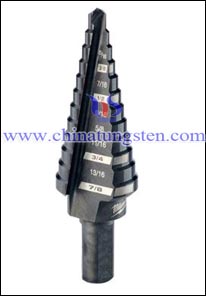
In last part we know that a tungsten carbide step drill bit (unibit) is a conical bit for hole enlarging with straight or angled transitions from smaller to larger diameters. Smaller ones are self-starting, while larger ones need a predrilled hole. This part we talk about the advantage of and suitable work piece materials for a step drill bit.
The advantage to the tungsten carbide step drill bit is that both diameters have the same flute characteristics, which keeps the bit from clogging when drilling in softer materials, such as aluminum; in contrast, a drill bit with a slip-on collar does not have the same benefit.
One tungsten carbide step drill bit can drill the entire range of holes necessary on a countertop, speeding up installation of fixtures. They are most commonly used on softer materials, such as plywood, particle board, drywall, acrylic, laminate and in general construction. They can be used on very thin sheet metal, such as metal sheet up to 1/4 of an inch thick, but metals tend to cause premature bit wear and dulling.
(To be continued. This article is divided into 5 parts. Here is part 2. For part 1, please refer to http://news.chinatungsten.com/en/tungsten-information/80507-ti-10400; for part 3, please refer to http://news.chinatungsten.com/en/tungsten-information/80509-ti-10402)
| Tungsten Carbide Supplier: Chinatungsten Online tungsten-carbide.com.cn |
Tel.: 86 592 5129696; Fax: 86 592 5129797;Email: |
| Tungsten News&Tungsten Prices, 3G Version: http://3g.chinatungsten.com | Molybdenum News & Molybdenum Price: http://news.molybdenum.com.cn |
Tungsten Carbide Step Drill bitsⅠ
- Category: Tungsten Information
- Published on 18 November 2015
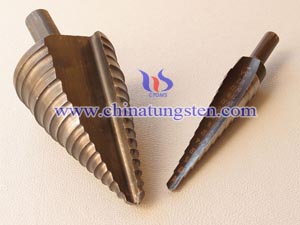
A tungsten carbide step drill bit, also called unibit, is a roughly conical bit with a stairstep profile. It is a drill bit that has the tip ground down to a different diameter. Each step on the bit is larger in diameter than the step before. The transition between this ground diameter and the original diameter is either straight, to form a counterbore, or angled, to form a countersink. Due to its design, a single bit can be used for drilling a wide range of hole sizes.
Smaller tungsten step drill bits are self-starting and no pilot bit is required to start the hole. On larger step drill bits, you need to have a hole pre-drilled that is equal in diameter to the smallest step on the bit. The larger-size bits have blunt tips and are used for hole enlarging. Most of these bits are custom-made for each application, which makes them more expensive.
(To be continued. This article is divided into 5 parts. Here is part 1. For part 2, please refer to http://news.chinatungsten.com/en/tungsten-information/80508-ti-10401)
| Tungsten Carbide Supplier: Chinatungsten Online tungsten-carbide.com.cn |
Tel.: 86 592 5129696; Fax: 86 592 5129797;Email: |
| Tungsten News&Tungsten Prices, 3G Version: http://3g.chinatungsten.com | Molybdenum News & Molybdenum Price: http://news.molybdenum.com.cn |