Titanium Based Tungsten Trioxide Denitration Catalyst
- Category: Tungsten Information
- Published on 19 May 2016
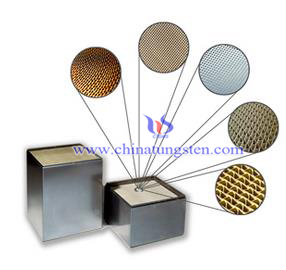 Titanium is a silvery-white transition metal, which is considered as a rare metal, with the properties of light-weight, high-strength, metallic luster, moisture chlorine corrosion; its most common compound is titanium dioxide, which is often used as the carrier of denitration catalyst. The typical plate denitration catalyst is based on stainless steel and coated with a catalyst paste (ingredients: titanium dioxide, vanadium pentoxide, tungsten trioxide and molybdenum trioxide, etc.).
| Tungsten Oxide Supplier: Chinatungsten Online www.tungsten-oxide.com |
Tel.: 86 592 5129696; Fax: 86 592 5129797;Email: |
| Tungsten News & Prices, 3G Version: http://3g.chinatungsten.com | Molybdenum News & Molybdenum Price: http://news.molybdenum.com.cn |
Testing Standards of Carbon Sulfur Analyzer and Tungsten Granule——Test Conditions and Test Methods
- Category: Tungsten Information
- Published on 19 May 2016
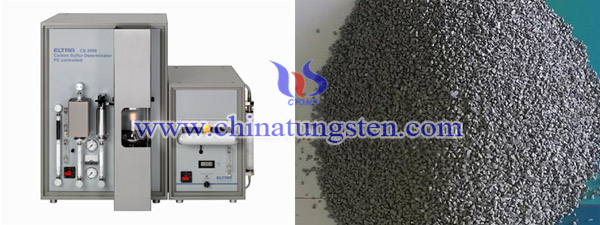
Except the technical requirements, testing standards of carbon sulfur analyzer and tungsten granule also include - test conditions, test methods, management of the results of treatment, re-testing period. The relative standard deviation of carbon is lower than 1.0%, sulfur should be lower than 4.0%, the analysis time should less than one minute, the weighing stability of less than 0.002 grams. Environment conditions for testing should meet the standards. The ambient temperature should be controlled between 15 ℃ to 30 ℃, relative humidity must be less than 80%. If it is measured against the amount of 0.0010% to 0.0100% of the carbon and sulfur, the relative humidity should be less than 60%. Power supply is (220 ± 4.4) V, (50 ± 1) Hz, and it should be ensured that the detection environment has no strong vibration, no strong electric, no active gases and without any impede of magnetic fields.
The main test equipments and materials for detection should be in accordance with national standards. Using the approved the steel components by the state metrological administrative department to analyze national primary, secondary reference material. Uncertainty of the determination of carbon and sulfur less than one-third of error of indication, weighing with 1g standard weights. According to visual indication and touch to detect the appearance of instrument. The instrument is required to be preheated on the basis of instructions before detecting. Select carbon content within the range from 0.100% 1.000%, and choose sulfur content within the range from the 0.010% to 0.100%, weighing 0.5 g of sample every time, repeated detecting for 7 times, calculating the standard deviation and relative standard deviation in according with the standard formula calculation method . Weighing with 1 g standard weight, continuously weighing for six times, the difference between the maximum and the minimum is called weighing stability. After the test is completed, certificate of qualification can be sent, if unqualified, pointing out that the failed project. Test cycle usually two years. While moving, repairing or doubting on the measurement results, users can test the instrument.
If the carbon sulfur analyzer used by the company are not included in the mandatory verification of measuring instruments catalog, on the other hand, these instrument are not applied in trade settlement, safety, health, environmental monitoring, there is no need to test it compulsively.
| Tungsten Metals Supplier: Chinatungsten Online www.tungsten.com.cn |
Tel.: 86 592 5129696; Fax: 86 592 5129797;Email: |
| Tungsten News & Prices, 3G Version: http://3g.chinatungsten.com | Molybdenum News & Molybdenum Price: http://news.molybdenum.com.cn |
Cubic Hydrogen Tungsten Bronze Crystal Structure
- Category: Tungsten Information
- Published on 18 May 2016
| Tungsten Oxide Supplier: Chinatungsten Online www.tungsten-oxide.com |
Tel.: 86 592 5129696; Fax: 86 592 5129797;Email: |
| Tungsten News & Prices, 3G Version: http://3g.chinatungsten.com | Molybdenum News & Molybdenum Price: http://news.molybdenum.com.cn |
Glass Furnace Flue Gas SCR Denitrification Catalyst Uses Tungsten Trioxide
- Category: Tungsten Information
- Published on 18 May 2016
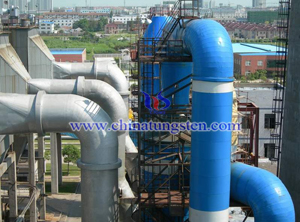 There are many sources of nitrogen oxides, in which glass furnace flue gas is the main one. The mass of nitrogen oxides in the glass furnace flue gas emissions is up to 14 million tons per year. Furthermore, with the advance of modernization, the consumption of housing and car growing; plus the new growth point of solar glass industry, all these resulting in increasing demand for glass, glass industry continues to develop, thus nitrogen oxide emissions rise.
| Tungsten Oxide Supplier: Chinatungsten Online www.tungsten-oxide.com |
Tel.: 86 592 5129696; Fax: 86 592 5129797;Email: |
| Tungsten News & Prices, 3G Version: http://3g.chinatungsten.com | Molybdenum News & Molybdenum Price: http://news.molybdenum.com.cn |
Tungsten Trioxide Waste Plate Denitration Catalyst Recycles Metal Oxide
- Category: Tungsten Information
- Published on 18 May 2016
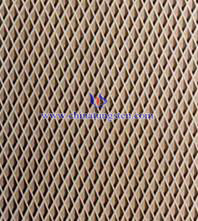 The main treatment methods of waste denitration catalyst currently are landfill, burning and recycling, the first two methods have huge potential dangers on the environment. In addition, due to full implementation of emission reduction, the waste catalyst generated increasingly; the treatment ways of landfill and incineration will not only occupy a lot of land, but also bring a secondary pollution to the environment. The way of recycling includes used as boiler slag recycling vulcanizing agent and raw materials recovery, thus to apply for the production of new catalyst, the raw materials of steel plants; wherein, heavy metal with toxic and its relatively components must be separated. The way of basic recycling titanium, vanadium and tungsten from tungsten trioxide waste plate denitration catalyst is as follows:
| Tungsten Oxide Supplier: Chinatungsten Online www.tungsten-oxide.com |
Tel.: 86 592 5129696; Fax: 86 592 5129797;Email: |
| Tungsten News & Prices, 3G Version: http://3g.chinatungsten.com | Molybdenum News & Molybdenum Price: http://news.molybdenum.com.cn |
Tungsten Carbide Pellet Dimensional Accuracy
- Category: Tungsten Information
- Published on 18 May 2016
From the technology point of view, tungsten carbide pellets subject to granulation, vibration sieving, drying, and isostatic pressing processes. Differ from other tungsten carbide products, tungsten carbide pellets forming not by molding tolls, which rub through sieve procedure using particle weight on a rotating granulator powder adhesion and continuous scrolling and raised molding, and finally by isostatic pressing, so it has a certain density and strength. However, before the isostatic pressing, the density of each carbide pellet is relatively uneven, which makes the sintering step, and after the isostatic pressing, the pellets of the larger size of the deviation, inconsistent shrinkage factor is different.
Tungsten carbide pellets size controlling has a direct impact on its density, semi-finished products grew scroll speed pellets and pellet density showed a decreasing relationship. When the grains grows fast, the corresponding density pellets products decreased by optical observation can be found isostatic pressing pressure can effectively reduce the porosity of carbide pellets inside, but the density has been improved, although the size has changed small, and further reduction in size after sintering shrinkage occurs over negative tolerance of waste. By metallographic observation can be found isostatic pressing pressure can effectively reduce the porosity of carbide pellets inside.
Take YQ3 tungsten carbide pellets as example, YQ3 mixture rubber solution 80-90ml added to gasoline and glue seepage uniform mixture in a mixing vessel, after glue seepage into the stainless steel tray into the drying cabinet for drying, and steam pressure control in a certain time within the appropriate range. After the particles strike-through screen wipes material into the granulator rolling a certain time, and then glue seepage abrasive powder sieved added granulator particles adhered to the surface so that it will roll up, by size requires careful observation confirmed pellet density, shape and size, until the pellet surface emit. After several experiments, the semi-finished pellet size upper and lower tolerance limits to control the shrinkage factor for the average size of the finished product plus finished lower limit value to determine the dimensional tolerance limit endorsement pellet product size.
| Tungsten Carbide Supplier: Chinatungsten Online tungsten-carbide.com.cn |
Tel.: 86 592 5129696; Fax: 86 592 5129797;Email: |
| Tungsten News&Tungsten Prices, 3G Version: http://3g.chinatungsten.com | Molybdenum News & Molybdenum Price: http://news.molybdenum.com.cn |
Tungsten Carbide Pellet
- Category: Tungsten Information
- Published on 18 May 2016
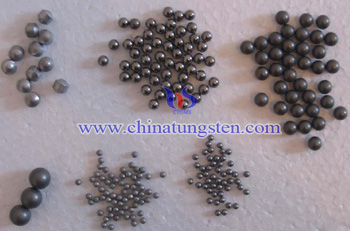
Tungsten carbide pellet is also known as tungsten carbide bead, which abbreviate to YQ. It is composed of refractory metal carbides (WC, TiC) micron powder with high hardness as main component and Co, Ni, etc. as a binder, which sintered in a vacuum furnace or the reduction furnace powder metallurgy products. Tungsten carbide pellets is one of species of tungsten carbide ball, its volume is relatively small (diameter typically between φ0.3-φ1mm), mainly used for transmission, pen, etc.
In addition, tungsten carbide ball has many types and applications, such as rough ball, grinding ball, punching ball, ball bearings, ball valves, non-magnetic ball, Monel balls, balls through holes, measuring ball, scraping color ball and so on. The grades for common use includes, YG6,YG6x,YG8,YG13,YG20,YN6,YN9,YN12,YG5,YT15. Due to its higher hardness and tensile strength, excellent wear resistance and corrosion resistance and other advantages, it can almost replace the similar products by steel ball. With the rapid development of related technology, it places higher requirements on the component, using performance and dimensional accuracy of tungsten carbide pellets. In general, tungsten carbide pellet uses spray, acetylene welding or heat injection process to form wear-resistant layer on the surface of metal material and improve the wear resistance and corrosion resistance of the material. It also requires tungsten carbide pellets have high roundness and good compactness, which can effectively improve the flowability and distribution during the process of welding. However, due to the different requirements of different materials, metal surface, the corresponding particle composition and size distribution of carbide pellets are not the same, which bring some difficulties to control of dimensional accuracy.
| Tungsten Carbide Supplier: Chinatungsten Online tungsten-carbide.com.cn |
Tel.: 86 592 5129696; Fax: 86 592 5129797;Email: |
| Tungsten News&Tungsten Prices, 3G Version: http://3g.chinatungsten.com | Molybdenum News & Molybdenum Price: http://news.molybdenum.com.cn |
Thoriated Tungsten Electrode Second Phase Research after Machining Deformation
- Category: Tungsten Information
- Published on 18 May 2016

Thorium tungsten electrode after machining deformation, the second phase had some obvious different changes. By analyzing the second phase changes after recrystallization, 202 rotary swaging and finished electrode, understand the impact of deformation on second phase of electrode.
After recrystallization, more second phase of thorium tungsten electrode had maintained spherical shape and small showed elongated rugby-ball like shape, or broken. This is mainly because a lot of residual stress disappeared after recrystallization annealing, so the internal stress of the electrode was in equilibrium, and tungsten matrix grains in the recovery and recrystallization process, the second phase showed spherical shape. Spherical shape is in favor of reducing electrode stress, in subsequent processing to prevent internal cracks. In addition, the spherical shape of second phase can be better deformation with the tungsten matrix to improve the mechanical properties of the electrode. Meanwhile, spherical second phase distribution in grain boundaries of tungsten matrix can effectively inhibit the cracks expansion in grain boundary.
And small second phase showed rugby-ball like mainly because during hot rolling cogging there were excessive external force, making the second phase not time moved to tungsten matrix, but it creates plastic deformation. Besides, there was fragmentation in the axial direction.
After 202 rotary swaging, the second phase elongation along with axial direction and most showed rice-like shape. When the deformation isn’t large, it can still maintain the ability to deformation with tungsten matrix. And a part of the second phase particles will be broken, mainly because deformation increased and deformation temperature reduced, so tungsten matrix deformation capacity will gradually decrease. And recovery and recrystallization grains will gradually shift to the dislocation cells, then if the second phase affected by the significant external force will occur fragility fracture.
With the deformation increased, tungsten matrix showed significant fibrous tissue. The second phase particles interrupted distributed in tungsten matrix with fibrous tissue. With the degree of deformation increased, the deformation ability has been behind the tungsten matrix, and easy to occur brittle fracture. Making rice-like second phase broke into smaller particles while leaving a large hole, which is not suitable for further processing. Otherwise it will generate a lot of cracks.
| Tungsten Metals Supplier: Chinatungsten Online www.tungsten.com.cn | Tel.: 86 592 5129696; Fax: 86 592 5129797;Email: |
| Tungsten News & Prices, 3G Version: http://3g.chinatungsten.com | Molybdenum News & Molybdenum Price: http://news.molybdenum.com.cn |
Thoriated Tungsten Electrode Microstructure Research after Machining Deformation
- Category: Tungsten Information
- Published on 18 May 2016
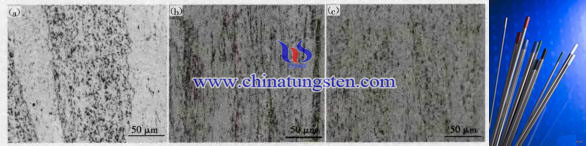
To obtain thoriated tungsten electrode should process a series of machining deformation processing on tungsten blank. Machining deformation of thorium tungsten electrode mainly includes swaging cogging, recrystallization annealing, 203 rotary swaging, 202 rotary swaging, 201 rotary swaging, drawing, straightening, polishing, and finally be finished. Selected three typical stages in the whole process analyze thorium tungsten electrode microstructure change, which were sampled in three stages of recrystallization annealing, 202 swaging and finished products.
After recrystallization annealing, tungsten matrix of thoriated tungsten electrode had very obvious grain boundaries, and along the axial direction grain boundaries was relatively flat. Besides, the grains of tungsten matrix were thicker and had certain of extension. There were many fine black spherical particles in electrode internal, which is the second phase.
After 202 rotary swaging, the grains of tungsten matrix became slender, and had clearer boundaries. Different with recrystallization stage, there was a certain fibrotic. The grains of tungsten substrate along the axial direction to extent, the coarse grains became long and thin. What’s more, the second phase distributed more evenly, but still maintained a spherical or near spherical shape.
With deformation increasing, the grain boundary of tungsten matrix in finished thoriated tungsten electrode gradually became blurred, and the crystal grains completely replaced by fibrous tissue. Fibrous tissue elongates along with the axial direction of the electrode. The second phase particles distributed more evenly.
From the above analysis, thorium tungsten electrode during machining deformation, with increasing deformation, the tungsten matrix gradually turns to fibrosis and distribution of second phase particles becomes more uniform. Besides, the second phase is mainly composed of Th, O and W three elements.
| Tungsten Metals Supplier: Chinatungsten Online www.tungsten.com.cn | Tel.: 86 592 5129696; Fax: 86 592 5129797;Email: |
| Tungsten News & Prices, 3G Version: http://3g.chinatungsten.com | Molybdenum News & Molybdenum Price: http://news.molybdenum.com.cn |
Testing Standard of Carbon Sulfur Analyzer and Tungsten Granule——Technical Requirements
- Category: Tungsten Information
- Published on 18 May 2016
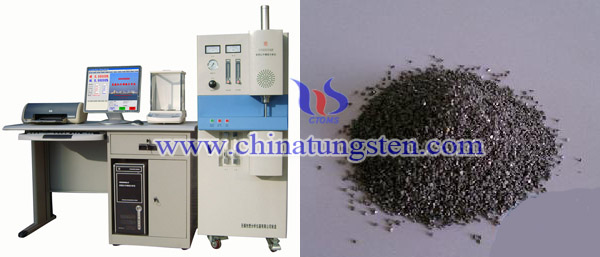
Generally speaking, carbon sulfur analyzer refers to the generic terms of the instruments which are used to analyze the content of carbon and sulfur of the ferrous metallic material. This type of equipment is easy to operate, with the efficient and high-precision analysis results and other excellent characteristics. It is widely used in the detection of carbon, sulfur and sulfur dioxide content of metals, minerals, ceramics and other substances. The working principles of the instrument are follows: tungsten granule is added to the a certain weight sample as a flux, and then placed in a high-frequency heating furnace for a high temperature combustion, carbon and sulfur of samples will react with oxygen, then produce carbon dioxide and sulfur dioxide, entering to the testing room of carbon dioxide and sulfur dioxide through the gas path system with the carrier gas, and then analyze the content of carbon dioxide and sulfur dioxide by using the measured light intensity absorption. Finally, the data obtained content of carbon and sulfur. The whole machine adopts modular design, power supply system consists of two modules, which can avoid dust, and it is simple and reliable.
Testing standards of carbon sulfur analyzer and tungsten granule mainly consists of five parts: the technical requirements, test conditions, methods of identifying, management of the results of treatment as well as the re-testing period. In appearance of the instrument, it should be marked with the name of instrument, model number, manufacturer's name, license logo and number of manufacturing measuring instruments, date of manufacturing as well as the number of instruments. The appearance of the instrument cannot have any mechanical damage, and each member should be in a solid state, the function keys are intact, which is able to work properly.
For different measuring range, the error of the average value and standard value of the testing results cannot exceed the standard requirements. The indicating error of carbon content which is more than 0.0010 to 0.0100 is ± 0.0005%, the indicating error which is between 0.010 to 0.100 is ± 0.005%, and error of indication between the 0.100 to 1.000 is ± 0.010%, indication error between 1.00 to 3.00 is ± 0.03%. The standard of sulfur content is the same as the carbon content, the different is that the error of indication of sulfur between 0.100 ~ 0.300 is ± 0.010%.
| Tungsten Metals Supplier: Chinatungsten Online www.tungsten.com.cn |
Tel.: 86 592 5129696; Fax: 86 592 5129797;Email: |
| Tungsten News & Prices, 3G Version: http://3g.chinatungsten.com | Molybdenum News & Molybdenum Price: http://news.molybdenum.com.cn |