Porosity of Cemented Carbide
- Category: Tungsten Information
- Published on Monday, 09 October 2017 20:49
Definition:
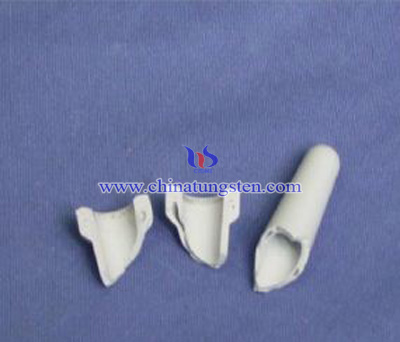
Porosity refers to the holes in the cross section of green bodies or products. When developing to a certain extent, the porosity will run through the green bodies. There are two kinds of porosity in injection forming: central shrinkage cavity and honeycomb pore. Contraction cavities can be seen in the following picture.
Contributing Factor and Improvement Measures
In summary, the factors responsible for forming voids are as follows:
A) Gas is occluded when injection, the feeding is uneven and undesirable filling.
B) the powder is separated from the binder.
C) Mould temperature and material temperature are different.
D) The packing pressure is too small and the holding time is insufficient.
(E) Spraying-up (solution: improving the mould design in the mold filling process to make sure the plunger type movement. Reducing mold temperature or injection temperature and reducing injection speed).
The reason for the shrinkage of cemented carbide in injection molding is that when the injection temperature is too high, the binder expands considerably (the volume expansion rate of paraffin from solid phase to liquid phase is 11%~20%).
When the volume fraction increases, the loading capacity of the feed decreases, and the shrinkage of the binder occurs when the injection mold is cooled, resulting in the formation of the central shrinkage hole. Main solution is to keep the injection temperature at a lower temperature.
Since that the gas in the mold cavity cannot be discharged in time during the filling process, the nest porosity and the inclusion is formed in the injection blank. When the feed temperature is too low and the feed viscosity is too large, the mold filling and exhaust emissions become worse.
In addition, because the injection speed is too fast, the gas in the feed cannot be discharged in time. By adjusting the matching rate between injection speed and injection temperature, the honeycomb hole was eliminated.
- Tungsten Carbide Manufacturer & Supplier, Chinatungsten Online: tungsten-carbide.com.cn
- Tungsten News & Prices of China Tungsten Industry Association: www.ctia.com.cn
- Molybdenum News & Price: news.molybdenum.com.cn
-
Tel.: 86 592 5129696; Fax: 86 592 5129797; Email:
This email address is being protected from spambots. You need JavaScript enabled to view it.