Injection Moulding - Surface Imperfection
- Category: Tungsten Information
- Published on Monday, 09 October 2017 20:42
Cemented carbide powder has higher hardness, wear resistance and deformation resistance. These characteristics make it necessary to select a more refined process in the injection molding process. Within a certain range, the quality of the injection blank can be controlled by controlling the injection parameters.
Meanwhile, cemented carbides are particularly sensitive to small impurities, voids, or other fracture sources caused by small defects. Therefore, it is very important to study the possible defects and their causes in the process and put forward preventive measures and solutions. Among them, surface defects occupy a large proportion.
There are two common surface defects: surface depression and surface flowing lines. They are usually caused by improper control of the raw material and injection process.
Causes of surface depression and improvement measures:
Specific surface depression of cemented carbide as shown in figure 1.
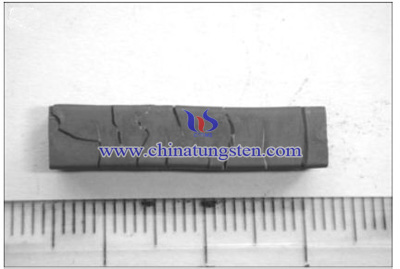
a) Cold flow, that is, the filling of the material before the filling of the mold cavity, the first part of the mold has begun to fill the mold. Increase the mold temperature or remove with a better liquid binder.
b) Separation of powder and binder, which is caused by too high temperature or too high injection temperature and too low viscosity in the process of mixing, and can reduce the injection heating temperature properly.
c) Mismatch of the temperature and the temperature of the mold causes the partial heat to retract and leads to the depression of the surface; the die can be eliminated by proper heating.
d) The packing pressure is small and the holding time is short, which leads to the local compaction. Can increase the holding pressure and holding time to be eliminated.
Causes of surface flow lines and improvement measures:
The wave shape on the surface of the injection blank is the surface flowing pattern. Reasons are that the viscosity of the feed is large, the fluidity is poor, and the friction between the die and the die wall increases. The friction between the feed and the die wall also depends on the machining accuracy of the die. The higher the surface smoothness of the mold cavity, the smaller the probability of flowing grains. In the actual injection process, the defects can be eliminated by increasing the injection speed and increasing the injection pressure at the proper injection temperature.
- Tungsten Carbide Manufacturer & Supplier, Chinatungsten Online: tungsten-carbide.com.cn
- Tungsten News & Prices of China Tungsten Industry Association: www.ctia.com.cn
- Molybdenum News & Price: news.molybdenum.com.cn
-
Tel.: 86 592 5129696; Fax: 86 592 5129797; Email:
This email address is being protected from spambots. You need JavaScript enabled to view it.