Mould Requirement for Slip Casting
- Category: Tungsten Information
- Published on Monday, 04 December 2017 19:31
In the process of grouting, the water in the mud near the mold wall will be sucked away because of the capillary water absorption of the plaster mold, forming the original attachment layer. As the water in the mud is further sucked away, the shape of the body is formed. After the young slab shrinkage, a green body with certain strength forms.
1, Slip Casting Process of Tungsten Carbide
1.1, Injected into the cavity, the water in the mud near the cavity wall is first absorbed under the effect of the capillary action of the plaster mold. The particles in the mud begin to close, forming an attachment layer.
1.2, As the water is further absorbed, the diffusion force at this time is the pressure difference and the concentration difference of water. The attachments gradually become thicker and the internal water diffuses to the outside. When the thickness of the part is reached, the body is formed.
1.3, After the body is formed, the graphite mold will further collect the water. The body begins to shrink, and the surface moisture is evaporated. When the water content of the body is reduced to a certain degree, the mold can be removed, and the grouting process is completed.
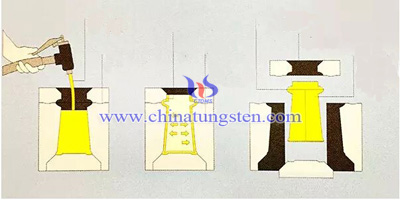
2, Mould Requirement for Slip Casting
2.1, Good water absorption and sufficient moisture absorption speed shorten the grouting period.
2.2, A certain mechanical strength, mechanical strength including tensile, compressive strength and so on to ensure that the body will not be deformed.
2.3, Smooth surface and no attachments on the inner surface of the mould.
2.4, The mold design should be easy to knockout. At the same time, the design should be minimized.
2.5, Water absorption of each part should be consistent, so that the contraction of the body is consistent.
2.6, The water absorption of the mould remains about 5%, and the overdrying will cause the crack of the body, and the overwetting will lead to the long grouting time, and even cannot be formed.
- Tungsten Carbide Manufacturer & Supplier, Chinatungsten Online: tungsten-carbide.com.cn
- Tungsten News & Prices of China Tungsten Industry Association: www.ctia.com.cn
- Molybdenum News & Price: news.molybdenum.com.cn
-
Tel.: 86 592 5129696; Fax: 86 592 5129797; Email:
This email address is being protected from spambots. You need JavaScript enabled to view it.