Tungsten Carbide Slip Casting Process
- Category: Tungsten Information
- Published on Monday, 04 December 2017 19:25
In the process of tungsten carbide slip casting, the mixture of powder and mother liquid is first made into slurry, which are then grouted in a specific plaster mold. After the grouting and a period of dehydration, the blank body is removed. After that, the body is dried, and the grouting process is finished.
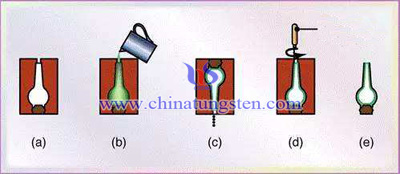
1, Preparation of Tungsten Carbide Slurry
The slurry preparation is powder and liquid are poured into the container and keep stirring to obtain homogeneous suspension no aggregation of particles so far.
Slurry is composed of mixture and mother liquor. Mother liquid is usually a liquid adding a variety of additives. The common additives are adhesives, dispersants, suspending agents (or stabilizers), degassing agents and titrants, of which the effect is to bond the powder body when it is cured and dry.
The commonly used adhesives in production are sodium alginate and polyvinyl alcohol. The role of dispersant and suspending agent is to prevent particle aggregation, make stable suspension, improve the wetting condition of powder and mother liquor, and control the settling velocity of powder. Water is a very good dispersant. Due to it is easy to oxidize the metal powder and difficult to obtain a stable suspension, it is often necessary to add a certain number of suspending agents.
2, Manufacture of Plaster Mold
The granularity and composition of gypsum powder should be paid attention to in the manufacture of plaster mold, and the dispersion of gypsum powder will be improved to improve the water absorption capacity of the mould. Firstly, the manufacturing process of plaster mould is to dry the gypsum powder with water and urea first. Then, the dry plaster mold is poured into the box, and the plaster can take out the core slightly.
3, Pouring
In order to prevent the pouring of the castable from the gypsum mold, the coating should be sprayed to the wall of the gypsum mold before pouring, which is usually called mold release. The commonly used mold release has silicone oil. Additionally, a thin layer of soapy water can be applied to the wall of the plaster mold to prevent direct contact between the powder and the mold wall. The soap film can also control the speed of water absorption of the plaster mold, preventing the casting from producing cracks because of the rapid contraction.
4, Dry
After the slip is poured into the plaster mold for a long time, the plaster mold can absorb the liquid in the slurry. Usually, the drying time depends on the actual effect.
- Tungsten Carbide Manufacturer & Supplier, Chinatungsten Online: tungsten-carbide.com.cn
- Tungsten News & Prices of China Tungsten Industry Association: www.ctia.com.cn
- Molybdenum News & Price: news.molybdenum.com.cn
-
Tel.: 86 592 5129696; Fax: 86 592 5129797; Email:
This email address is being protected from spambots. You need JavaScript enabled to view it.