Why Have Tungsten Prices Fallen? - October 15, 2026
- Category: Tungsten's News
- Published on Thursday, 15 October 2026 14:00
Analysis of Latest Tungsten Market from Chinatungsten Online
Tungsten prices continued to face downward pressure, with bearish sentiment dominating spot trading. The market has yet to form a unified consensus where the bottom lies.
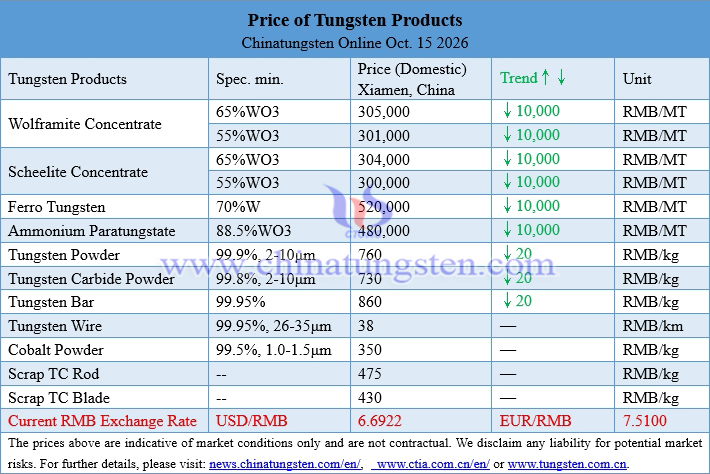
According to data from China Tungsten Online, more than 55% of tungsten concentrate prices are testing the key psychological level of RMB 300,000/standard ton. Mainstream quotes for ammonium paratungstate (APT) stand at approximately RMB 470,000-480,000/ton. Tungsten powder prices are generally in the range of RMB 720,000-760,000/ton, while some tungsten carbide powder deals are probing levels below RMB 700,000/ton. Prices across the tungsten industry chain remain under pressure overall, with thin spot transactions and still-sluggish market liquidity.
▏Why Have Tungsten Prices Continued to Fall?
The root cause often lies in capital pressure. As caution grows and activity slows on the consumption side, holders and traders, who previously withheld stock in hopes of higher prices now face a need to recover capital, prompting them to lower prices to offload inventory. Once low-priced deals emerge, the market quickly takes note, fueling the spread of panic. Other holders, previously on the sidelines, fear further price declines and join the sell-off, creating a stampede effect: selling drives prices down, which in turn triggers further selling.
This panic has disrupted pricing stability. The market no longer has a consistent reference price; instead, there is significant confusion in negotiations. Buyers are pushing for deeper discounts, while sellers are forced to adjust their prices downward. For products of the same grade or specification, the gap between different sellers' quotes has widened. This lack of orderly pricing amplifies uncertainty, further dampening the willingness to trade.
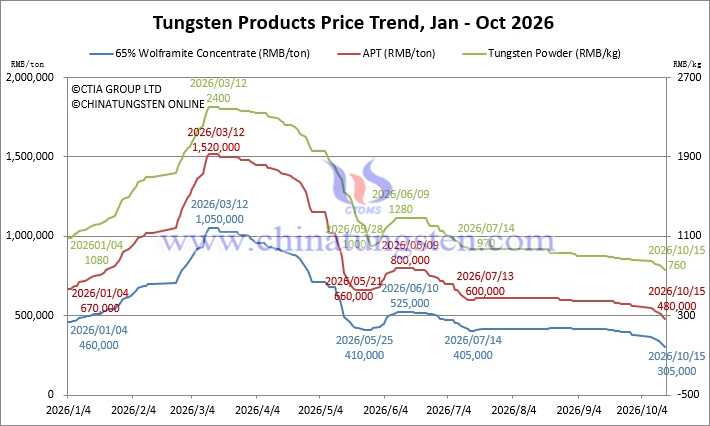
Meanwhile, the demand side has failed to provide effective support. Since the downturn in tungsten prices began in March, orders from traditional downstream sectors, such as the cemented carbide industry, have been slow to materialize, with companies generally adopting a replenish-as-needed procurement strategy. A brief rebound between late May and early June spurred some restocking, but it lacked staying power; subsequent price declines further eroded market confidence. To cope with the dual pressures of inverted margins and weak demand, smelting and powder-production enterprises have generally reduced their operating rates. Most market transactions are now limited to small, back-to-back orders based on immediate, essential needs, with large-volume orders becoming increasingly rare.
Driven by panic and financial pressure, sellers are eager to offload inventory, while buyers, wary of weak demand and price uncertainty, have become increasingly cautious. This widening gap in price expectations has pushed transaction levels lower. Each new, lower-priced deal acts as a catalyst for further panic, creating a negative feedback loop. In this process, emotional panic has accelerated capital clearance, capital clearance has intensified quotation disorder, and quotation disorder has amplified the perception of supply-demand mismatch, ultimately making it difficult for prices to find an equilibrium point in the short term.
▏Where Is The Bottom for Tungsten Prices?
Looking back at the previous market cycle, the price of tungsten concentrate climbed from approximately 140,000 yuan per standard ton to nearly 1.05 million yuan—a nearly one-sided ascent over the course of a year. Having now retreated by 70% from its peak, this current decline will likewise not continue indefinitely.
On the supply side, factors such as natural resource endowment, as well as strict compliance requirements regarding mining and trade, mean that the volume of available resources remains relatively controllable. On the demand side, tungsten serves as a critical material for traditional industrial sectors, including cemented carbides, cutting tools, and high-temperature alloys, ensuring a certain degree of rigidity demand. Furthermore, persistent strategic requirements for national defense, with many countries worldwide classifying tungsten as a protected critical mineral, provide potential medium- to long-term support for prices, underscored by the metal’s strategic value and inherent scarcity.
Nevertheless, the tungsten market remains cautious and relatively weak for now. Clear signals of a substantive recovery in downstream demand have yet to appear, the clearance of speculative inventories is still ongoing, and bulls and bears continue to probe and contest the specific bottom level. A true bottom confirmation typically emerges only after panic has been fully released and upstream and downstream participants have rediscovered balance—or when clear policy intervention and support appear. Until then, rational observation and demand-driven operations remain the realistic choice for most participants. We believe the bubble in the tungsten products market has already been clearing at an accelerated pace, and all links in the industrial chain are gradually returning to rationality. We remain firmly convinced: dawn is approaching, and the light is just ahead!
Prices of Tungsten Products on October 15, 2026
Tungsten Price Trend from January to October 2026
- Chinatungsten Online: www.chinatungsten.com
- CTIA GROUP LTD: en.ctia.group
- Tungsten News & Price: www.ctia.com.cn
- Molybdenum News & Price: news.molybdenum.com.cn
-
Tel.: 86 592 5129696; Email:
This email address is being protected from spambots. You need JavaScript enabled to view it.