China Upgrades its Tungsten Resource Advantage to an Industrial Advantage
- Category: Tungsten's News
- Published on Thursday, 11 June 2026 19:19
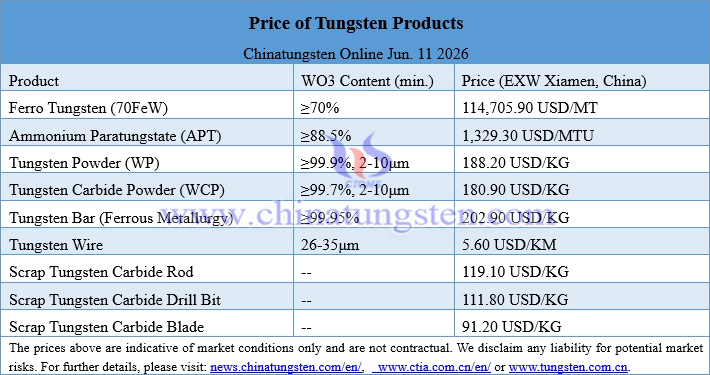
Prices of Tungsten Products on June 11, 2026
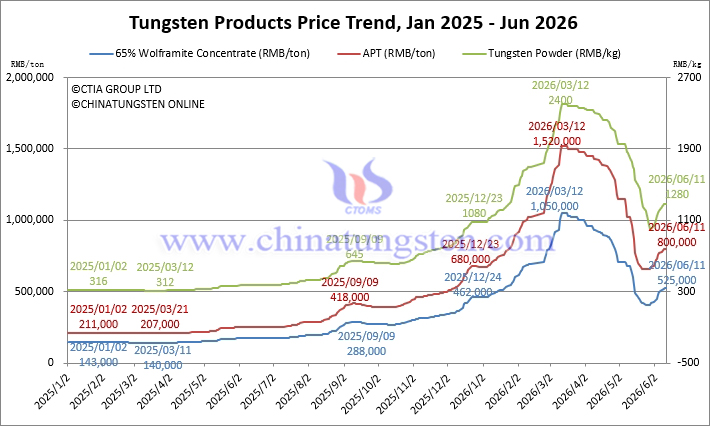
Tungsten Price Trend from January 2025 to June 2026
Analysis of Latest Tungsten Market from Chinatungsten Online
I. Tungsten Concentrate Supply Remains Limited, High-Price Transactions Becoming More Rational
A large tungsten company in Guangdong announced its long-term contract procurement guidance prices for the first half of June, which were largely in line with the current market situation, and the market did not experience significant fluctuations. As a representative company lacking its own mining resources and relying on external procurement of raw materials, its willingness to maintain stable prices was interpreted by the market as an acceptance of the current raw material price system, and also reflected the basic judgment of large consumers that they would not speculate on short-term price increases or be bearish.
Against this backdrop, mines continue to hold strong bargaining power. Supported by resource attributes, mining quotas, and future expectations, most mines have no intention of actively increasing supply. The trading sector is showing divergence: large traders who replenished their stocks at lower prices earlier believe that the tight resource situation has not changed and continue to maintain their price-supporting strategy; some traders who have already made a profit are moderately realizing their gains and recovering funds. Overall, the market has shifted from a period of uniform price increases to a phase of turnover at high prices, but profit-taking is relatively orderly and has not led to panic selling. On the contrary, it is conducive to improving market liquidity and consolidating the price foundation.
65% wolframite concentrate price: RMB 525,000/ton, down 50.0% from its peak, but up 14.1% year-to-date.
65% scheelite concentrate price: RMB 524,000/ton, down 50.1% from its peak, but up 14.2% year-to-date.
II. APT Prices Stabilize at High Levels, Industry Chain Needs Market Validation
Long-term contract prices for tungsten enterprises are basically in line with spot market prices, further stabilizing APT market sentiment. For smelting companies, this signal means that downstream large-scale consumer enterprises have a certain acceptance capacity for current cost levels, and also indicates that the necessity for significant price increases is weakening before a significant increase in end-user demand.
The current APT market is driven by both cost and demand. Smelters' procurement and production are more focused on existing orders, with limited willingness to actively expand inventory. Some companies remain optimistic about medium- to long-term price increases under resource constraints, while others are more focused on the fulfillment of end-user orders, adopting a low-inventory, fast-turnover operating strategy. In the short term, APT prices are likely to remain high, with the pace of recovery in end-user consumption determining the market direction in the next phase.
Ammonium paratungstate (APT) price: RMB 800,000/ton, down 47.4% from its peak, up 19.4% year-to-date.
European APT price: USD 2,900-3,180/mtu (equivalent to RMB 1.741-1.909 million/ton), down 3.2% from its peak, up 230.4% year-to-date.
III. Tungsten Powder Market Remains Cautious, Downstream Procurement Becomes More Pragmatic
Influenced by signals of stable long-term contracts, the tungsten powder, tungsten carbide powder, and alloy product markets are generally operating smoothly, with the tension following the rapid price increases easing significantly. Powder manufacturers are generally maintaining their existing pricing systems and are unwilling to offer concessions, while downstream customers are gradually accepting the current price levels, but their procurement methods are becoming more rational, focusing on replenishing inventory as needed and purchasing in batches.
Currently, the market is not lacking in genuine demand, but rather end-user companies are paying more attention to the pace of procurement and cost control. Some previously held orders are beginning to be released, but concentrated restocking has not yet occurred. For consumer companies producing cutting tools and cemented carbide products, the current price stability is a positive signal, beneficial for formulating production and sales plans. Therefore, price stability is more conducive to demand recovery than price increases. If prices continue to remain stable, end-user purchasing activity is expected to further increase.
Tungsten powder price: RMB 1,280/kg, down 46.7% from its peak, up 18.5% year-to-date.
Tungsten carbide powder price: RMB 1,230/kg, down 47.4% from its peak, up 18.3% year-to-date.
Cobalt powder price: RMB 540/kg, down 6.9% from its high this year, up 3.9% year-to-date.
IV. Tungsten Waste and Scrap Market Sentiment Fluctuates Significantly
Unlike the overall stable virgin tungsten market, the tungsten waste and scrap market experienced a slight correction due to market sentiment. For scrap tungsten varieties that had previously seen significant price increases, the support for high-priced transactions weakened after raw material prices temporarily stabilized. Some low-cost holders chose to take profits, leading to a softening of market quotations. Some holders who held stock at high prices in the first quarter are still reluctant to sell. Downstream enterprises' enthusiasm for purchasing scrap materials was dampened by market fluctuations and tax invoice policies, leading to a slowdown in overall market liquidity.
Scrap tungsten carbide rod price: RMB 810/kg, down 40.9% from its peak but up 35.0% year-to-date.
Scrap tungsten carbide drill bit price: RMB 760/kg, down 44.5% from its peak but up 31.0% year-to-date.
V. High-Tech Tungsten Products Industry Has Been Restructuring
The international tungsten market maintained high prices as supply chain shortages due to China's export controls were unlikely to be effectively alleviated in the short term, leading to a deeper restructuring of the global tungsten industry chain.
According to data compiled by China Tungsten Online from the General Administration of Customs, apart from direct exports of 16 tons of tungsten hexafluoride in March, China exported zero quantities of metallic tungsten powder, tungsten oxide, and other electronic specialty gases and military-related products to Japan for three consecutive months from February to April 2026. According to media reports, against this backdrop, leading Japanese electronic specialty gas companies Kanto Denka and Central Glass have successively issued market warnings, indicating that due to limited supply of key raw materials, their electronic specialty gas businesses, such as tungsten hexafluoride, may reduce or even halt production starting July 1st. This means that Japan's semiconductor materials system, which has long relied heavily on Chinese tungsten raw material supplies, is experiencing for the first time the pressure from critical mineral supply chain security issues. However, data also indicates that to alleviate these pressures, Japan has actively increased its imports of tungsten products from Europe, the United States, and other regions.
The impact of this event has transcended the purely trade level. From a practical perspective, my country's control over key mineral resources has already demonstrated a strong restraining effect on specific countries, industries, and time windows. In the future, the use of this resource tool cannot be ruled out as either a phased relaxation or a long-term, precise, or even expanded application. For high-end manufacturing industries that heavily rely on stable supplies, the continuity and predictability of raw material supply are often more important than price itself.
From an industrial competition perspective, this change presents both challenges and opportunities. For a long time, European, American, and Japanese companies have dominated the high-end tungsten materials, electronic specialty gases, and precision products sectors thanks to their first-mover advantage, while Chinese companies have largely remained at the resource and primary processing stages. Now, the logic of global supply chain security is being restructured, and downstream customers are placing significantly higher demands on supply stability, beginning to re-evaluate the comprehensive advantages of Chinese companies in resource security, cost control, and rapid response. This not only creates a new window for Chinese companies in the tungsten hexafluoride, tungsten powder, cemented carbide, and cutting tool industries to gain international market share, but also provides an unprecedented strategic opportunity for Chinese companies to narrow the technological and market gap with leading Western companies, and even achieve partial surpassing.
Overview
The long-term contract prices of major tungsten enterprises in the first half of June were basically in line with the current market situation, reflecting the leading companies in the industry chain's acceptance of the current price level and stabilizing market expectations to some extent. The current tungsten market has gradually transitioned from a sentiment-driven phase after the rapid price increases to a phase of supply and demand rebalancing and rational competition. Mines' control of supply rhythm continues to support prices, midstream companies are operating with stable prices and controlling risks, downstream companies are gradually resuming their purchasing pace amidst price stability, and the scrap tungsten market has seen localized price corrections due to sentiment adjustment.
Meanwhile, the industrial influence brought about by China's advantages in key mineral resources is becoming increasingly apparent. Resource control is gradually evolving from a traditional cost advantage to a supply chain bargaining power advantage, profoundly impacting the procurement logic and industrial layout of global high-end manufacturing. For Chinese companies, this not only means temporary gains during price cycles, but also a significant historical opportunity to upgrade from resource export to technology export, and from scale advantage to comprehensive competitive advantage.
In the short term, tungsten industry chain prices are likely to remain stable at high levels, allowing time to create space and exchange gains for consensus. In the medium to long term, as inventories are gradually depleted, end-user demand continues to be released, and the global supply chain restructuring deepens, my country's tungsten industry is expected to achieve enhanced value and further strengthen its international influence in the new round of competitive landscape adjustments.
- Chinatungsten Online: www.chinatungsten.com
- CTIA GROUP LTD: en.ctia.group
- Tungsten News & Price: www.ctia.com.cn
- Molybdenum News & Price: news.molybdenum.com.cn
-
Tel.: 86 592 5129696; Email:
This email address is being protected from spambots. You need JavaScript enabled to view it.