Gradient Film Material - Zirconium Tungstate
- Category: Tungsten Information
- Published on Thursday, 17 August 2017 11:32
With the rapid development of electronic information industry, the scale of integrated circuit is on the rise day by day. And the energy produced on each chip is also increasing, leading to improvement of temperature. Therefore, there are increasingly high requirements towards the electronic device materials around the chip.
The thermal expansion coefficient of silicon is quite different from that of interconnect material copper used in microelectronic chips. For example, the thermal expansion coefficient of silicon is 2.4x10⁻⁶/℃, and the thermal expansion coefficient of copper is 16.6.x10-6/℃. Therefore, the increase of heat will definitely lead to the thermal stress of the interface. Using gradient film to mitigate thermal stress is one of the ways to solve the thermal stress problem caused by mismatch of thermal expansion.
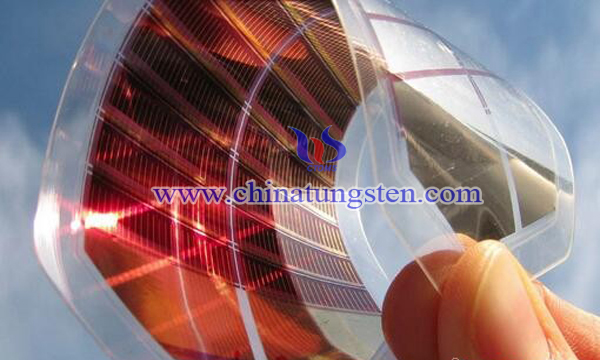
Gradient film is film of functionally graded materials, overcoming the large thermal stress in conventional homogeneous film. The thermal expansion coefficient of the film increases slowly or decreases with the continuous change of microstructure and properties, thus greatly reducing the thermal stress in the film. What kind of material is suitable as a functionally graded material? Experienced scholars naturally think of the popular negative thermal expansion material - zirconium tungstate.
Research shows that zirconium tungstate (ZrW2O8) is a kind of high quality negative thermal expansion material which is isotropic in the temperature range from -273℃ to 777℃. When added into the metal to form a metal zirconium tungstate composite material, it can effectively reduce the low thermal expansion coefficient. And obtained metal composite also exhibits high thermal conductivity.
Based on the above principle, the zirconium tungstate (ZrW2O8/Cu) gradient composite film is prepared by RF magnetron sputtering, combining zirconium tungstate with copper. The prepared ZrW2O8/Cu gradient film not only neutralizes the difference of thermal expansion coefficient between silicon and copper, but also has excellent properties of high thermal conductivity, high conductivity and low expansion which are the advantages of the above two raw materials. Plagued by high temperatures for a long time, electronic chips finally freed from chains and have stimulated higher potential with the help of gradient film.
In the Internet age, we are enjoying the convenience of the rapid development of electronic products all the time. Design architecture is important, but material technology should not be overlooked. CPU, for example, which is considered the heart of a computer or cell phone, has evolving from the earliest single kernel computing to dicaryon, quad cores, and eight cores. Its every upgrade is driving the upgrading of electronic products. Thanks to the application of some new materials, such as zirconium tungstate film, we can make the electronic chip products faster and maintain excellent stability at the same time.
| Tungsten Supplier: Chinatungsten Online www.chinatungsten.com |
Tel.: 86 592 5129696; Fax: 86 592 5129797;Email: |
| Tungsten News & Prices, 3G Version: http://3g.chinatungsten.com | Molybdenum News & Molybdenum Price: http://news.molybdenum.com.cn |