Nano Pt Supported Tungsten Trioxide Photocatalyst
- Category: Tungsten Information
- Published on Friday, 27 May 2016 17:31
Dye wastewater is the persistent problem in all kinds of pollutants because of its complex composition, high chroma and emission, toxicity, and poor biodegradability properties. Internationally, the commonly used treatment methods are physical chemical decolorization, suction filtration-incineration, however, both of them are of relatively high limitation. Nano-titanium dioxide as the photocatalytic functional material, has the advantages of energy efficient, chemically stable, non-toxic, strong oxidizing power, low energy consumption, plus the effectively pollutants removal in air and water, thus to become an ideal material to solve the energy problem. The band gap (E = 3.2eV) of titanium dioxide is relatively high, which shows it can only be excited at shorter wavelength ultraviolet light, but can’t good use the other bands of light energy, which precisely limits its application; in addition, its very low light conversion efficiency (less than 4%) makes it can’t use solar energy efficiently, therefore the research and development of highly active photocatalyst which is responsive to visible light has become very popular.
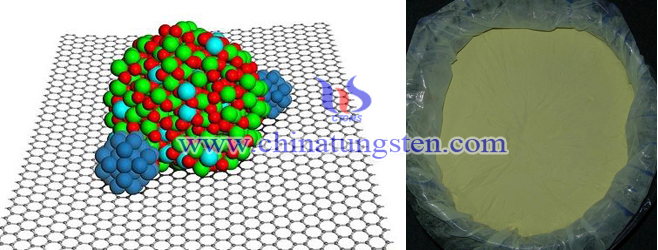
Tungsten-based catalyst, such as elemental tungsten, tungsten oxide, tungsten sulfide and tungsten heteropolyacid, all of them have good catalytic performance to denitration, hydrodesulfurization, oxidation, isomerization of hydrocarbons, alkylation reaction. In particular, tungsten trioxide is a relatively inexpensive and very important tungsten compound, which not only has good photochromic properties and gas sensing performance, but also has good photocatalytic properties, and they can either call the main catalyst or co-catalyst.
Study has found that tungsten trioxide has a lower band gap (2.4~2.8eV), which indicates that it can take advantage of a larger band of light, in particular, to effectively utilize the sun's visible light. However, it is precisely within a narrow band gap, single photocatalyst of tungsten oxide has smaller oxidation-reduction capacity; in addition, the e- and holes H+ generated from tungsten oxide semiconductor photocatalyst by light excitation, but its photocatalytic activity will be greatly reduced because of the combination of H+ and e-. Therefore, the key to improve the catalytic activity of the photocatalyst is how to reduce the recombination rate, extend the life of H + and e-. Some studies indicate precious metal nano-Pt-supported tungsten trioxide photocatalyst has high photocatalytic activity, which can effectively solve the problem of low activity of tungsten oxide photocatalyst; while it can also effectively use visible light, widen its field of application. The method is as following:
1. Dissolve tungsten trioxide particles into absolute ethanol or methanol or isopropanol, then carry out ultrasonic vibration, centrifugation and vacuum drying to stand-by after magnetic stirring;
2. Add the tungsten oxide after the pre-treatment to the glass tube, and then add of chloroplatinic acid and methanol solution, magnetic stirring, ultrasonic vibration, recanalization after nitrogen gas sealed glass tubes;
3. Light reaction, under the condition of magnetic stirring, the glass tube obtained in step 2 is placed under high pressure mercury lamp light for reaction, take out the sample after complete the reaction, and then centrifuged, washed by deionized water and ethanol, dried, ground to powder, finally to obtain nano Pt supported tungsten trioxide photocatalyst.
| Tungsten Oxide Supplier: Chinatungsten Online www.tungsten-oxide.com |
Tel.: 86 592 5129696; Fax: 86 592 5129797;Email: |
| Tungsten News & Prices, 3G Version: http://3g.chinatungsten.com | Molybdenum News & Molybdenum Price: http://news.molybdenum.com.cn |