☰

中钨在线新闻网

  • Home
  • Tungsten News
    • Tungsten's News
    • Tungsten Information
    • Tungsten Statistics Data
    • Tungsten Patents
    • Tungsten Dart News
    • Rare Earth News
    • Tungsten Jewelry News
    • Sapphire Growth Furnace
    • Smart Glass
  • Tungsten Video
  • Tungsten Audio
  • Tungsten Price
    • Tungsten Metal Price
    • Tungsten Electrodes Price
    • Tungsten Alloy Price
    • Tungsten Military Parts Price
    • Tungsten Carbide Price
    • Tungsten Powder Price
    • Tungsten Carbide Powder Price
    • Tungsten Oxide/Trioxide Price
    • Ammonium Metatungstate
    • Tungsten Concentrate Price
    • Ferro Tungsten Price
    • Tungsten Jewelry Price
    • Gold Plated Tungsten Price
    • Tungsten Dart Price
    • Tungsten Fishing Sinkers Price
    • Tungsten Copper Price
    • Tungsten Bucking Bar Price
    • Sapphire Growth Furnace Price
  • About Us
    • About Us
    • Contact Us
    • Visit Us
  • Disclaimer
    • Terms & Conditions
    • Agent
    • Privacy Policies
    • Intellectual Property
    • Recycle Policy
    • Disclaimer
    • Statement
  • Language
    • 繁體中文
    • 繁體中文
    • 日本語
  • 简体中文
  1. Home
  2. Tungsten Information

What Is a Tungsten Filament?

Category: Tungsten Information
Published on 11 September 2014
A tungsten filament is a thin strand of the metal which glows very brightly when an electric current is passed through it. When coiled and sealed inside a glass container filled with an inert gas, a tungsten filament can glow brightly enough to light up a room. It was the inclusion of a tungsten filament in his electrical lighting system that resulted in the world giving Thomas Edison credit for inventing the electric light bulb when in fact dozens of scientists had been experimenting with electric light.
 
Tungsten is an element (Symbol: W; Atomic Number 74) discovered in the late 18th century. Almost twice as dense as lead, it has the highest melting point of all the metals at 6192 ° F (3422 ° C); of all the elements, only carbon’s melting point is higher. These properties make tungsten very useful not only in electric technology, but also for military applications such as hardening weapons. Another use of tungsten is as a component of jewelry, where it’s combined with other materials to form very hard and lustrous compounds, although they can be brittle.
 
When Thomas Edison and other scientists were working on developing the electric light bulb, they experimented with a number of materials for the light-producing filament. Until the early 20th century, the most successful incandescent light bulbs utilized a filament of carbonized bamboo, which lasted about 1,200 hours. Edison wasn’t the first to use tungsten, which was introduced as an incandescent light bulb filament in Europe in 1904.
 
In 1906, Edison's company General Electric (GE) developed a process for making pure tungsten flexible enough to draw into a coiled wire. Using a coiled wire allowed GE to increase the surface area of tungsten that would be inside the bulb. By 1911, the company was manufacturing and selling light bulbs using the new filaments, which outlasted all others. Advances in this technology continued almost uninterrupted, so that the cost of operating an incandescent bulb by the turn of the 21st century was less than 5% of what it was in 1911.
 
Despite its success as the light source for incandescent bulbs, tungsten filament is remarkably inefficient in producing light. About 90% of the power used in operating an incandescent light bulb is emitted as heat, not light. As more efficient methods of producing light have been developed, most notably fluorescent lighting and light emitting diodes (LEDs), some have called for the banning of incandescent bulbs as an energy conservation measure.
 
 
Tungsten Manufacturer & Supplier: Chinatungsten Online - http://www.chinatungsten.com
Tel.: 86 592 5129696; Fax: 86 592 5129797
Email: This email address is being protected from spambots. You need JavaScript enabled to view it.
Tungsten & Molybdenum Information Bank: http://i.chinatungsten.com
Tungsten News & Tungsten Prices, 3G Version: http://3g.chinatungsten.com
Molybdenum News & Molybdenum Price: http://news.molybdenum.com.cn

 

Industry Specifications for Tungsten Alloys

Category: Tungsten Information
Published on 11 September 2014

In August of 1986 the last revision of the “Proposed Military Specification” for Tungsten Base Metal, High Density (MIL-T-21014D) was issued. In use for many years this specification defined the requirements for four classes of machinable, high density tungsten base metal produced by consolidating metal powder mixtures comprised primarily of tungsten. The alloy classes differed in tungsten content and density. The specification defined four slightly magnetic tungsten alloys (containing Ni-Fe binders) and three nonmagnetic tungsten alloys (containing Ni-Cu binders) in terms of their composition, mechanical properties, and machinability. ASTM approved a standard containing essentially the same content in 1987. The most recent revision of the ASTM standard (ASTM B777-07) was published in November of 2007 and is the active standard for tungsten alloys at this time. A third standard was introduced in August of 1998 by the Society of Automotive Engineers (SAE Technical Standard AMS-T-21014). All three of these standards contained the same set of mechanical properties for the various alloy classes. These properties are summarized in the table below.


Class Nominal
Weight of Tungsten (%) 
Density (g/cm3) Hardness
(Rc max.) (1)
Elongation
(% min.) (2)
Ultimate Tensile Strength
(ksi min.)
Yield Strength
at 0.2% Offset
(ksi min.)
 1 – Magnetic 90.0 16.85 – 17.25 32 5 110 75
 2 – Magnetic 92.5 17.15 – 17.85 33 5 110 75
 3 – Magnetic 95.0 17.75 – 18.35 34 3 105 75
 4 – Magnetic 97.0 18.25 – 18.85 35 2 100 75
 1 – Non-mag 90.0 16.85 – 17.25 32 2 94 75
 2 – Non-mag 92.5 17.15 – 17.85 33 2 94 75
 3 – Non-mag 95.0 17.75 – 18.35 34 1 94 75
 
1. For mechanically worked or aged material, the hardness can be as high as Rc 46.
 
2. Determine with an extensometer accurate to 0.5% elongation or less.
 
 
Tungsten Manufacturer & Supplier: Chinatungsten Online - http://www.chinatungsten.com
Tel.: 86 592 5129696; Fax: 86 592 5129797
Email: This email address is being protected from spambots. You need JavaScript enabled to view it.
Tungsten & Molybdenum Information Bank: http://i.chinatungsten.com
Tungsten News & Tungsten Prices, 3G Version: http://3g.chinatungsten.com
Molybdenum News & Molybdenum Price: http://news.molybdenum.com.cn


Brazing Tungsten Carbide Components

Category: Tungsten Information
Published on 11 September 2014
Tungsten carbide components are commonly joined to steels and other materials by brazing. Brazing involves placing a metallic braze alloy along with a fluxing agent between the components to be joined and then heating the assembly until the braze alloy melts and flows to fill completely the small gap between the two components. Soldering is similar to brazing, but is performed at lower temperatures with lower melting point alloys. Soldered joints, however, generally lack the mechanical or thermal strength to satisfy the requirements of many applications.
 
Although many variables determine the quality and strength of the bond between two brazed components, attention to a few important principles usually leads to a satisfactory result. Both the carbide and the steel components must be clean so that the molten braze alloy wets their surfaces completely and forms a strong chemical bond with each. Tungsten carbide components are often grit blasted, sanded, or ground to create clean, new surfaces, or plated or treated in salt baths to prepare the surfaces for brazing. Similarly, steel components are vapor degreased or cleaned with solvents or caustic solutions. The presence of any residual grease, oil, oxidation, dirt, or other surface contaminants adversely affects the wetting of component surfaces by the braze alloy and results in an inferior joint. Various tests of the flow of molten braze alloys over component surfaces are commonly used to assess the “brazeability” of the components. The relative importance of clean surfaces will, however, vary with the design and application of the brazed assembly.
 
Under the right conditions all common braze alloys from pure copper to silver alloys will readily wet cemented carbide surfaces. The most popular braze alloys (American Welding Society designations shown in parentheses) consist of approximately 50% silver and include alloys with cadmium (BAg-6), without cadmium (BAg-24), with manganese (BAg-22), and with tin (BAg-7). These alloys possess moderate melting points in the range 1150 to 1300ºF and can be purchased in wire, rod, or ribbon form or as a trimetal braze in which a copper shim is “sandwiched” between two layers of silver alloy. Braze alloy manufacturers are a good source of detailed information on the selection and use of these products.
 
For high temperature applications copper is typically used as the brazing material. Although copper has a lower tensile strength than the silver alloys at room temperature, copper retains much of its strength to temperatures approaching 1000ºF . If brazing is carried out in an oxidizing environment, borax is an effective flux for copper. Normally, however, copper brazing is performed in a hydrogen atmosphere where no flux is needed. Other high temperature brazes include high nickel alloys containing some chromium, boron, and silicon. These alloys flow at temperatures exceeding 1800ºF. It should be noted that high brazing temperatures may cause grain growth or other unwanted changes in the steel component.
 
Fluxes are generally used in combination with the braze alloy to minimize the oxidation of surfaces to be joined during the heating of the assembly. Both “white” and “black” fluxes are commonly used in combination with the silver alloys listed above. The two are similar except that the “black” flux has a higher boron content and therefore is more effective at higher brazing temperatures.
 
The basic brazing steps follow.
 
Lightly apply flux to the steel surface.
Position a precut piece of braze alloy on the steel and lightly coat with flux.
Position the tungsten carbide component and coat the outside surfaces with flux.
Heat the assembly evenly throughout its volume to the proper temperature.
Once the braze alloy is molten, jiggle the carbide slightly to allow any flux or fumes to escape. Do not press too firmly or the braze alloy will be forced out of the joint.
Allow the assembly to cool slowly. Make no attempt to cool the assembly quickly.
Wash off any excess flux with hot water.
The optimal thickness of a braze joint is believed to be about 0.004 inches. This thickness represents a compromise between the high strengths associated with very thin joints and the superior ability of thicker brazes to absorb thermal and mechanical strains acting on the joint. Brazing strains are minimized by brazing only one surface between the carbide and steel components. Cemented carbides expand and contract only about one-half as much as most steels. If the carbide component is constrained during either heating or cooling, excessive stresses can develop and failure by cracking may occur. If the braze joint consists of two or more surfaces, the design of the joint must allow the carbide component adequate room during heating and cooling. The brazing of a carbide ring to a steel core, for example, is a very tricky case. Brazing strains become more significant in larger or longer joints. In such cases, various design considerations are utilized alone or in combination to avoid the problem.
 
Methods of heating the assembly to be brazed include hand torches, batch furnaces, and high frequency induction coils. Torch flames should be somewhat reducing to minimize oxidation of component surfaces. It is important to heat the entire assembly uniformly to minimize thermal gradients and stresses and to reach, but not exceed the proper brazing temperature. Underheated brazes will not melt and flow properly. Overheating may cause low boiling point constituents in the braze alloy to boil off. This alters the properties of the alloy and may result in entrapped gas bubbles in the braze joint. Any environmental factor that influences the rates of heating and cooling of the braze joint must be controlled to insure that the quality of the braze joint does not vary.
 
 
Tungsten Manufacturer & Supplier: Chinatungsten Online - http://www.chinatungsten.com
Tel.: 86 592 5129696; Fax: 86 592 5129797
Email: This email address is being protected from spambots. You need JavaScript enabled to view it.
Tungsten & Molybdenum Information Bank: http://i.chinatungsten.com
Tungsten News & Tungsten Prices, 3G Version: http://3g.chinatungsten.com
Molybdenum News & Molybdenum Price: http://news.molybdenum.com.cn


Tungsten Alloy Applications in the Military Industry

Category: Tungsten Information
Published on 11 September 2014

New materials, also known as Advanced Materials, refers to the new materials, which was found in recent successful studies and undergoing researches, with superior features, functions and able to meet the need of high-tech. Development of human history shows that material is the material basis and pilot of social development and the new material is a milestone of social progress.Materials technology has been a very important field in the world's national science and technology development planning, together with information technology, biotechnology, energy technology, are recognized as high-tech in today's society and for a long time dominate human technology. National defense force is often the prior user of new materials technology achievement, and the study and development of new material technology play a decisive role in the development of national's defense industry and weapon equipments.

The melting point of tungsten is the highest in metals, and its outstanding advantages is the high-temperature strength and crossion-resistance, which showing excellent properties inmilitary industry , especially weapon manufacturing.It is mainly used for manufacturing armor piercing bullet in weapon industry.

The armor-piercing bullet that in China's main battle tank 125 Ⅱ type is made of W-Ni-Fe, with variable density of sintering press, the average performance can achieve tensile strength 1200 MPa, elongation of more than 15%, tactical and technical index of 2000 meters homogeneous from the breakdown of 600 mm thick steel armor. Presently, tungsten alloys are widely used in large ratio armor-piercing in main battle tank, small and medium-caliber anti-aircraft penetrators and high-speed anti-piercing material , which makes this kind armor-piercing with more powerful breakdown.


Tungsten Alloy Manufacturer & Supplier: Chinatungsten Online - http://www.tungsten-alloy.com
Tel.: 86 592 5129696; Fax: 86 592 5129797
Email: This email address is being protected from spambots. You need JavaScript enabled to view it.
Tungsten & Molybdenum Information Bank: http://i.chinatungsten.com
Tungsten News & Tungsten Prices, 3G Version: http://3g.chinatungsten.com
Molybdenum News & Molybdenum Price: http://news.molybdenum.com.cn


Tungsten Alloys in the Construction of National Defense

Category: Tungsten Information
Published on 11 September 2014

1.In the aerospace industry applications. China developed the first generation of tungsten heavy alloy performance good in the 1960s, since immediately after the birth of self-developed China’s first artificial satellite navigation device has been successfully applied, then this new material has the first in China an intercontinental missile and developed by a variety of new fighters, helicopters, has been successfully applied. Developed to meet the needs of Chinese communications satellite, but also successfully developed a new type of density up to 18.5g/cm3 high proportion of tungsten-based alloys. A variety of high-performance W-Cu alloys in the rocket (missile) combustion chamber, nozzle, throat, rudder and other parts of the development of high temperature has been applied.

2.Military industrial applications. China has successful developed the W-Ni-Fe heavy alloy, provides of a variety of wear, shaped charge of the development a key material. W-Ni-Cu heavy alloys also play an important role in doing gyrorotor high proportion of material in China’s first nuclear submarine of the research and development.

3.In the civilian industry and nuclear industrial applications. In the nuclear power industry, used for nuclear reactor insulation and shielding materials, tungsten heavy alloy has a good prospect. In civilian industry, high-density tungsten alloy has been more widely used, mobile phones and golf oscillator rod weight will be a wide range of products. Processing done in the electric performance of the anvil block material to make electrical upsetting of hundredfold increase production efficiency, has significant economic benefits.


Tungsten Alloy Manufacturer & Supplier: Chinatungsten Online - http://www.tungsten-alloy.com
Tel.: 86 592 5129696; Fax: 86 592 5129797
Email: This email address is being protected from spambots. You need JavaScript enabled to view it.
Tungsten & Molybdenum Information Bank: http://i.chinatungsten.com
Tungsten News & Tungsten Prices, 3G Version: http://3g.chinatungsten.com
Molybdenum News & Molybdenum Price: http://news.molybdenum.com.cn

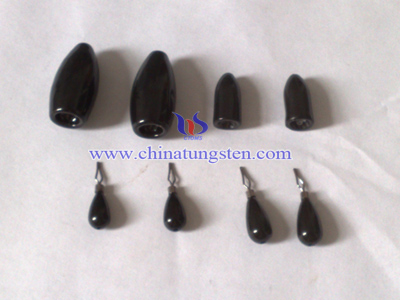
Tungsten Walking Fishing Sinkers

Category: Tungsten Information
Published on 11 September 2014

These fishing sinkers are the bread and butter of many live-bait, walleye fisherman. They resemble a rectangle with rounded, outside edges. The top features an eye for the line. The fishing sinker's bottom is slightly wider and larger in size than the top, holding more weight. The bottom is also slightly rounded and bent upwards.

This weight distribution positions the sinker with its round edge on bottom, so it will easily glide over rocks, greatly reducing its changes of snagging on the bottom. The semi-flat design also prevents it from rolling along bottom in fast currents.

These sinkers are often used to drag live bait rigs along the bottom, and are sometimes called a live bait rig. To tie the rig, first thread the sinker on the line with the bottom bend pointing to the line's tag end.

Next, select a swivel large enough so it will not pass through the sinker's eye. Tie one end to your main line to the swivel. Then, you can add anything from a floating jig head, a plain hook, or a worm harness to complete the rig. This rig is not only snag-resistant, but it also allows line to slide through its eye when a fish picks up the bait.

This latter feature prevents a fish from feeling weight. Yet, when an angler keeps a tight line on the rig, the swivel will stop at the sinker's opening, allowing the leader's length to remain consistent and in the strike zone.

tungsten-fishing-weights


Tungsten Alloy Manufacturer & Supplier: Chinatungsten Online - http://www.tungsten-alloy.com
Tel.: 86 592 5129696; Fax: 86 592 5129797
Email: This email address is being protected from spambots. You need JavaScript enabled to view it.
Tungsten News & Tungsten Prices, 3G Version: http://3g.chinatungsten.com
Tungsten News & Tungsten Prices, WML Version: http://m.chinatungsten.com


Application of Tungsten Alloy Ball

Category: Tungsten Information
Published on 10 September 2014
Tungsten alloy ball is used as the hunting shot for shotguns. A shotgun is a firearm that is usually using pellet filled shells instead of using bullets. The shot pellets from a shotgun spread upon leaving the barrel, and the power of the burning charge is divided among the pellets, which means that the energy of any one ball of shot is fairly low. In a hunting context, it makes shotguns useful primarily for hunting birds and other small games.
 
Advantages of Tungsten Alloy Ball in Military
 
Tungsten alloy ball provide a safer, non-toxic and environmentally friendly alternative to lead. Their higher density enables them to hold their shape better, even under extreme conditions. While depleted uranium offers comparable density, its volatile nature and the special licensing requirements needed for radioactive materials make working with it difficult and expensive. We offers a variety of high-density alloys, available as ROTF (Rough, Over-sized to Finish) material, bars, spheres, plates or rods. We also have extensive machining capabilities, allowing us to provide crankshaft weights in standard sizes or custom products finished to your exact specifications.
 
 
Tungsten Manufacturer & Supplier: Chinatungsten Online - http://www.chinatungsten.com
Tel.: 86 592 5129696; Fax: 86 592 5129797
Email: This email address is being protected from spambots. You need JavaScript enabled to view it.
Tungsten & Molybdenum Information Bank: http://i.chinatungsten.com
Tungsten News & Tungsten Prices, 3G Version: http://3g.chinatungsten.com
Molybdenum News & Molybdenum Price: http://news.molybdenum.com.cn


Application of Tungsten in Modern Industry

Category: Tungsten Information
Published on 10 September 2014
Tungsten is a silvery lustrous dense hard metal with the atomic number 74. Among all chemical component tungsten has the second highest melting point, while carbon having the highest. Even tungsten has the second highest boiling point comes after the metal rhenium and it is at the 8th rank in highest density that can be comparable to uranium and gold. Unlike the metal tin, aluminium or zinc, Tungsten has a very low toxicity.
 
The Average abundance of the material can be found in the continental Earth crust. The metal tungsten is widely used as hard metal in the form of tungsten carbide. It is indispensable for cutting and wears surfaces purposes like wood cutting, metal machining, petroleum exploration and mineral drilling. Tungsten is also used in great demand as a special hardening agent in the segment like armaments, steels, electronic, lighting and chemical industries.
 
The modern technology has a wide range of applicability for the unique metal tungsten. The distinct combination of properties of the metal such as highest melting point over all other metals, great density as well as low reactivity or toxicity are unbelievable and could not be found in any other single metal.
 
The following are some major use of tungsten in different industrial sectors:
 
A global consumption 61% of tungsten has been observed in the form of Cemented carbides which is regarded as the major use for tungsten. This is a ceramic which offers extreme toughness and hardness. The Cemented tungsten carbide (WC) is well suited in the creation of a variety of machine tools like cutting tools, wear parts and drill bits. The most recent and advanced application of Cemented tungsten carbide are the segments like the automotive, aerospace & defence, the oil & mineral exploration along with the construction sector.
 
The other huge usage area of the unique metal is intended foe steels and super alloys. It contributes near about a 20% of share in 2011. A proportional mixture of tungsten in a few sorts of steels enhances their hardness, durability and corrosion resistance ability. Steels made from this type of material are useful for the purpose of making cutting or drilling tools. The tungsten-containing super alloy’s application in the area of aerospace industry and for making blades for jet engines is outstanding.
 
The application of tungsten in mill products in the form of metal use has only a share of merely 11% as compared to the global consumption. The tungsten material that we use in our day to day life comes under this group. The filament in light bulbs, the ammunition and armour, application in automotive and aerospace industry, the furnace elements, in jewellery, in electronics, medical, wide nuclear applications, the sports equipment and welding electrodes are examples of application of tungsten in mill products.
 
 
Tungsten Manufacturer & Supplier: Chinatungsten Online - http://www.chinatungsten.com
Tel.: 86 592 5129696; Fax: 86 592 5129797
Email: This email address is being protected from spambots. You need JavaScript enabled to view it.
Tungsten & Molybdenum Information Bank: http://i.chinatungsten.com
Tungsten News & Tungsten Prices, 3G Version: http://3g.chinatungsten.com
Molybdenum News & Molybdenum Price: http://news.molybdenum.com.cn


Tungsten and Tungsten Carbide: What You Should Know About Them

Category: Tungsten Information
Published on 10 September 2014
Tungsten and tungsten carbide have become increasingly popular options for jewelry, especially when it comes to rings. Let’s take a look at the characteristics of these two materials, and see what you should know about them when shopping for jewelry.
 
What Is Tungsten?
 
Tungsten is a metal that is extremely hard and melts at a very high temperature. It is also very dense, and the jewelry made of it feels surprisingly heavy.
 
Because of its durability, tungsten is a preferred material for buyers looking for jewelry that will last a very long time. However, the physical properties that make this metal so robust are also the reason jewelers find tungsten relatively hard to work with.
 
What Is Tungsten Carbide?
 
When tungsten is mixed with carbon, the resulting compound is called tungsten carbide. This material is even more durable than tungsten. The tungsten carbide used in jewelry making is usually mixed with a small amount of nickel.
 
Not only is tungsten carbide harder than tungsten, but it is also even tougher to fashion into a ring or another jewelry piece.
 
What You Should Know About Tungsten Carbide
 
Let’s look at the most important characteristics of tungsten carbide that you should be aware of when shopping:
 
Hypoallergenic: Tungsten carbide doesn’t cause allergic reactions when worn. Although the tungsten carbide used in jewelry usually does contain some nickel, this metal usually constitutes a small part of the final mixture. That’s why you shouldn’t worry about skin irritation if you are allergic to nickel and plan on wearing tungsten carbide jewelry.
 
Do make sure, however, that the vendor guarantees that the tungsten carbide jewelry offered is hypoallergenic. Different manufacturers have different standards for what their products contain, so it never hurts to check.
 
No scratches: One of the biggest selling points of tungsten carbide is that it is scratch resistant. It is very hard to make a dent or nick in a tungsten carbide ring under normal circumstances.
 
Tungsten carbide’s extreme durability means that if you have jewelry made of this material, it will stay polished for very long and won’t lose its luster with time, unlike gold or silver. Many companies selling tungsten carbide jewelry guarantee that their products won’t scratch and offer to replace them if you notice any scratches.
 
Cannot be resized: Tungsten carbide’s durability comes at a price: Rings made of this material cannot be resized. That’s why you should choose your size carefully to make sure your new ring is not too snug or loose. If, however, you finger size changes with time, you may be able to exchange your tungsten carbide ring for another of a different size: Some vendors offer such an option, so make sure to check when shopping.
 
Tungsten Carbide vs. Tungsten
 
People often use the terms tungsten and tungsten carbide interchangeably. However, there are differences in the properties of these two materials.
 
First, tungsten scratches more easily than tungsten carbide. Rings made only of tungsten are not really scratch resistant, so you shouldn’t expect them to stay as shiny as the ones made of tungsten carbide.
 
Second, tungsten jewelry often contains cobalt, whereas pieces made of tungsten carbide are usually mixed with nickel. The problem is that when cobalt comes in contact with your skin, the metal can cause irritation. Furthermore, cobalt can also oxidize and cause your tungsten jewelry to change in color.
 
 
Tungsten Manufacturer & Supplier: Chinatungsten Online - http://www.chinatungsten.com
Tel.: 86 592 5129696; Fax: 86 592 5129797
Email: This email address is being protected from spambots. You need JavaScript enabled to view it.
Tungsten & Molybdenum Information Bank: http://i.chinatungsten.com
Tungsten News & Tungsten Prices, 3G Version: http://3g.chinatungsten.com
Molybdenum News & Molybdenum Price: http://news.molybdenum.com.cn


What is Tungsten Carbide?

Category: Tungsten Information
Published on 10 September 2014
If you have heard a lot about tungsten carbide but are unsure of what it is or what benefits it could bring to your or your business, stick around. Tungsten carbide should be viewed as a chemical compound, formed in an inorganic way, which hosts the same number of tungsten atoms and carbon. It some ways, this helps to explain the name, being a balanced mix of tungsten and of carbon but many people will just refer to tungsten carbide and carbide.
 
Tungsten carbide has a great number of uses but taken at its simplest level, it is available in a powder, grey in colour. However, this powder can be taken and pressed which is then processed into a variety of shapes. These shapes can provide the foundation for many products including male jewellery, tools, abrasives and even industrial machines.
 
The fact that tungsten carbide is such a versatile compound means that it carries a great number of benefits and uses. The physical elements brought together and maintained by tungsten combined are quite rare but this only helps to make it a better foundation for so many products. Some of the biggest strengths of tungsten carbide lies in the fact that it is very durable and can resist wear and tear. With respect to tungsten carbide being cut or engraved, this means that there is just a limited number of materials available that can do the job. If you are looking to engrave or professionally cut tungsten carbide, a diamond or a diamond abrasive will be one of the best ways to get the job in an efficient and effective manner.
 
Tungsten carbide holds a high tensile strength but this means that it can become fragile or unreliable under extreme pressure. Anyone interested in tungsten carbide’s point of melting should note that it comes out at 2,870 °C which is equivalent to 5,200°F. In order to be able to boil tungsten carbide, the temperature levels have to be even higher, which means you would be looking at a heat of around 6,000 °C or 10,382 °F.
 
One of the most ways to create this compound is done by reacting carbon and tungsten at a temperature level of between 1,400 to 2,000 °C which is the equivalent of 2,552 to 3,632 °F. One of the major uses of tungsten carbide comes with industrial use with tools for cutting and even mills being made of the material.
 
 
Tungsten Manufacturer & Supplier: Chinatungsten Online - http://www.chinatungsten.com
Tel.: 86 592 5129696; Fax: 86 592 5129797
Email: This email address is being protected from spambots. You need JavaScript enabled to view it.
Tungsten & Molybdenum Information Bank: http://i.chinatungsten.com
Tungsten News & Tungsten Prices, 3G Version: http://3g.chinatungsten.com
Molybdenum News & Molybdenum Price: http://news.molybdenum.com.cn


Page 888 of 1117

  • Start
  • Prev
  • 883
  • 884
  • 885
  • 886
  • 887
  • 888
  • 889
  • 890
  • 891
  • 892
  • Next
  • End
 

WeChat


Latest Articles

  • Tungsten Scrap Prices Rise - October 26, 2026
  • Ferromolybdenum Prices Lowered - October 26, 2026
  • Light Rare Earth Prices Under Pressure - October 26, 2026
  • Tungsten Concentrate Prices Rise 12% This Week - October 23, 2026
  • Molybdenum Powder Prices Fall 3.7% This Week - October 23, 2026
  • Rare Earth Market - October 23, 2026
  • Scrap Tungsten Carbide Rod Prices Rise - October 22, 2026

Login Form

  • Forgot your password?
  • Forgot your username?

Link

  • Chinatungsten Online
  • Tungsten Video
  • Tungsten Information
  • Tungsten Image
  • Tungsten Blog
  • Molybdenum News
  • Tungsten Metals
  • Tungsten Alloy
  • Tungsten Carbide
  • Tungsten Powder
  • Tungsten Jewellery
  • Molybdenum
  • CTIA GROUP
  • Links