Recover Ammonium Paratungstate from Rubidium Tungsten Containing Fluorite
- Category: Tungsten Information
- Published on 03 February 2016
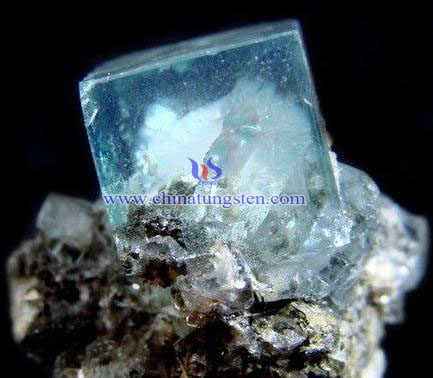
A processing that recover ammonium paratungstate from rubidium tungsten containing fluorite, which makes good economic benefits. Materials: rubidium tungsten containing fluorite which is the tailings selected by flotation, and it’s the hardest middling tungsten ore to recover valuable metal such as tungsten, rubidium and so on.
Specific process steps are as follows:
1. Drying, crushing and grounding rubidium tungsten containing fluorite to make it into powder;
2. Add concentrated sulfuric acid, stirring evenly and place it into the rotary kiln, keep the temperature at 200~350℃ for 2~5 hours;
3. Cooling down to room temperature, and then sent it into the ball mill to get baking powder;
4. Water leaching: adding water and keep temperature controlled at 70~90℃ for 2.0~3.0 hours, then we get leached solution and slag;
5. Washing the leached residue, the water washed can return to the leaching step for recycling;
6. Neutralized with NaOH to adjust pH value to 2.0~2.5, keep stirring, and then conduct ion exchange, crystallization to get ammonium paratungstate.
| APT Supplier: Chinatungsten Online ammonium-paratungstate.com |
Tel.: 86 592 5129696; Fax: 86 592 5129797;Email: |
| Tungsten News&Tungsten Prices, 3G Version: http://3g.chinatungsten.com | Molybdenum News & Molybdenum Price: http://news.molybdenum.com.cn |
Rod-like W Grain in W-Cu Electrode Formation—Powder Morphology(2/2)
- Category: Tungsten Information
- Published on 03 February 2016
By many trials and experimental data analysis and SEM photographs, the researchers summed up the possible causes of the four rod-shaped tungsten grain, and for its analysis and discussion. They are the influence of powder morphology, the rearrangement and combination of tungsten (W) grains in the process of microwave infiltration, the growth of grains caused by elution after infiltration and the growth of grains. This part we are concentrated on the influence of powder morphology. Theoretically, morphology of the powder particles directly affect flow ability of the powder and the suppression of performance, but also have a certain impact on the microstructure of the sintered body strength.
Viewed from the structure, tungsten powder is a typical cubic crystal structure, and thus the rod-shaped tungsten grain microwave infiltration is unlikely to be due after the tungsten powder material morphology caused. Then analyze the morphology of tungsten skeleton compact SEM picture, which has a large amount of bores, but there is no rod-like w grains. In addition, for the same group of powder, which was prepared under the same conditions (temperature, pressure, etc.), conventional copper infiltrated tungsten alloy electrode samples showed distinct grain growth mode, there is no obvious grain tungsten rod appears, which further proved a rod-shaped tungsten grains and powder morphology no direct link, but there is a certain connection with the microwave sintering in the microwave field.
| Tungsten Copper Supplier: Chinatungsten Online tungsten-copper.com |
Tel.: 86 592 5129696; Fax: 86 592 5129797;Email: |
| Tungsten News & Prices, 3G Version: http://3g.chinatungsten.com | Molybdenum News & Molybdenum Price: http://news.molybdenum.com.cn |
Rod-like W Grain in W-Cu Electrode Formation—Powder Morphology(1/2)
- Category: Tungsten Information
- Published on 03 February 2016
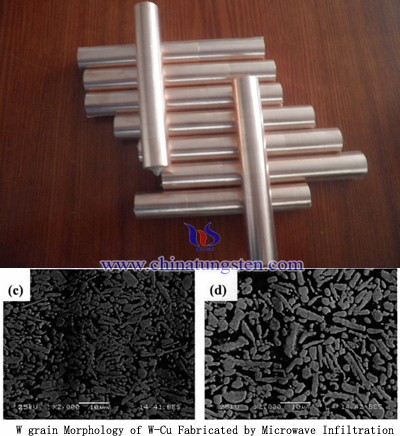
Compared with the conventional infiltrated samples, the most outstanding characteristic of tungsten copper electrode by microwave infiltration is that it has rod-like W grain in micro-structure. And tungsten copper electrode with rod-like W grain is remarkably improved in the hardness and other properties. This is due to rod-like W grain will enhance the fiber to some extent, while fiber reinforced metal matrix composites not only has better lateral mechanical properties, but also has excellent thermal conductivity and electrical conductivity, in the case of high temperature refractory metal oxide splash can be effectively controlled, has good wear and corrosion resistance.
Recent years, with the rapid development of domestic composite material industries, fiber reinforced composite material plays an important role in many fields, such as high pressure vessel, naval vessel, missile, satellite, air plane and so on. Therefore, to study the formation mechanism of rod-like W grain in tungsten copper electrode by microwave infiltration becomes a new research hotspot of related researchers and scholars. To produce W grain, which arranged in order and has orientated growth, is not only a breakthrough in scientific research or industry, but also a brand-new attempt of reinforced alloy manufacturing. There is W grain morphology of tungsten copper W-Cu fabricated by microwave infiltration as follow:
| Tungsten Copper Supplier: Chinatungsten Online tungsten-copper.com |
Tel.: 86 592 5129696; Fax: 86 592 5129797;Email: |
| Tungsten News & Prices, 3G Version: http://3g.chinatungsten.com | Molybdenum News & Molybdenum Price: http://news.molybdenum.com.cn |
pH Value Controlling Tungsten Trioxide Form
- Category: Tungsten Information
- Published on 03 February 2016
pH value refers to the hydrogen ion concentration index (hydrogen ion concentration; French: potentiel d'hydrogène) , which is the total number and the total mass of the amount of hydrogen ions in solution than its value, it is commonly known as "pH (English pronunciation: [pʰi. :. ɛɪ̯tʃ]. pH value is the most important physical and chemical parameters of aqueous solution , it is natural phenomenon involving chemical changes. Therefore, it is used in industry, agriculture, medicine, environmental protection and scientific research fields.
Hydrothermal method for its mild reaction conditions is more appropriate to prepare the hexagonal tungsten trioxide product because hexagonal tungsten trioxide stables in the range of 200 ℃ -400 ℃. We can easily change the parameters of the reaction in the hydrothermal reaction system, such as pH, can form different reaction environment to obtain a different product, the search for crystal formation mechanism of trade is very useful to explore.
pH Value Controlling Tungsten Trioxide Form content:
Preparing hexagonal tungsten trioxide in hydrothermal environment, the study shows that when pH = 0.5, the formation of pure tungsten trioxide is oblique direction; when pH = 1.0, the resulting is oblique direction tungsten trioxide and tungsten acid mixture; when pH = 1.5, the product is completely converted to tungsten trioxide hexagonal phase, but when the pH = 2.0, the tungsten trioxide is obliquely peaks. pH was controlled within the range of 1.5-2.0 , which can get hexagonal tungsten trioxide crystalline form.
| Tungsten Oxide Supplier: Chinatungsten Online www.tungsten-oxide.com |
Tel.: 86 592 5129696; Fax: 86 592 5129797;Email: |
| Tungsten News & Prices, 3G Version: http://3g.chinatungsten.com | Molybdenum News & Molybdenum Price: http://news.molybdenum.com.cn |
Ammonium Paratungstate Preparing Tungsten Trioxide
- Category: Tungsten Information
- Published on 03 February 2016
By drying and calcining sodium tungstate and ammonium paratungstate (APT) can prepare tungsten trioxide. Dried at temperature of about 100 ℃, with the main vaporisation of moisture the material is physically adsorbed and removed. Only at higher temperatures the material is calcined to remove molecule compounds and ammonia water of sodium tungstate and ammonium paratungstate.
When tungstic acid is usually calcined at 180 ℃ ,it is dehydrated dehydration at 500 ℃ completely, producing tungsten trioxide:
H2WO4=WO3+H2O
When ammonium paratungstate is heated and calcined in air at different temperatures , which will produce different phase, it transfers to tungsten trioxide when the temperature rose to about 500 ℃. Analyzing APT by differential thermal analysis and X-ray diffraction method calcination , which shows APT is heated in the air , its course as follows: at the temperature is not less than 240 ℃, APT is converted to ammonium metatungstate (AMT), continuing to have sublimation to 300 ~ 350 ℃, the conversion of the amorphous material (ammonium tungsten bronze ATB), the temperature rose to 400 ℃, it became into the hexagonal WO3, the temperature reached 500 ℃.
APT purity determines the purity of tungsten trioxide, APT crystalline form has hereditary to crystalline tungsten trioxide, the temperature of calcination and the rate of thermal decomposition has significant impact on the physical and chemical properties of the product tungsten trioxide. calcining the same batch of APT at different temperatures, the product WO3 surface area and particle size vary greatly, the calcination temperature is higher, resulting WO3 is more coarse.
Physicochemical properties of tungsten trioxide, not only depend on the calcination temperature, but also depend on the thermal decomposition rate and APT the duration time. It was found that rapid warming, rapid decomposition, the output of tungsten trioxide has wide and deep cracks, large specific surface area.
| Tungsten Oxide Supplier: Chinatungsten Online www.tungsten-oxide.com |
Tel.: 86 592 5129696; Fax: 86 592 5129797;Email: |
| Tungsten News & Prices, 3G Version: http://3g.chinatungsten.com | Molybdenum News & Molybdenum Price: http://news.molybdenum.com.cn |
Ammonium Paratungstate Used for Preparing Tungsten Carbide Wear-Resistant Coating
- Category: Tungsten Information
- Published on 02 February 2016
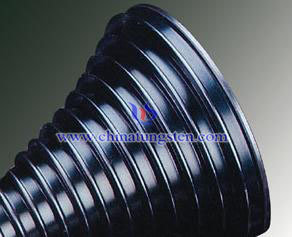
Wear-resistant coating is a kind of new functional coating with special function, such as good abrasion resistance. Tungsten carbide (WC), the kind of important hard alloy material, is a black six square crystal with metallic luster, which the hardness is similar to diamond. Because the properties tungsten has, it is increasingly becoming an important strategic significance material. A method for preparing tungsten carbide wear-resistant coating from ammonium paratungstate (APT) is presented in this paper.
Specific steps:
1. Calcining ammonium paratungstate to prepare tungsten oxide powder, control the temperature at 650~750℃;
2. Place the tungsten oxide powder in the reaction vessel, and adding one of alcohol, acetic acid and acetone, or the mixture of them, filter and get the light yellow tungsten oxide sol;
3. Heated and stirred to evaporate, and then the tungsten oxide gel was prepared;
4. Soaking hard alloy in he tungsten oxide gel, filming by dip-coating method, keeping the speed at 50~200mm/min;
5. Hard alloy coated with tungsten oxide nano film was prepared by drying and cooling;
6. Carbonization the hard alloy plated with tungsten oxide nano film in the reduction furnace full of reducing gas, which is carbide mixture gas of H2 and C2H2, temperature controlled at 950~1200℃ for 3~5 hours, then get the hard alloy plated with tungsten carbide wear-resistant coating.
| APT Supplier: Chinatungsten Online ammonium-paratungstate.com |
Tel.: 86 592 5129696; Fax: 86 592 5129797;Email: |
| Tungsten News&Tungsten Prices, 3G Version: http://3g.chinatungsten.com | Molybdenum News & Molybdenum Price: http://news.molybdenum.com.cn |
Ammonium Paratungstate Prepared from Tungsten Scraps
- Category: Tungsten Information
- Published on 02 February 2016
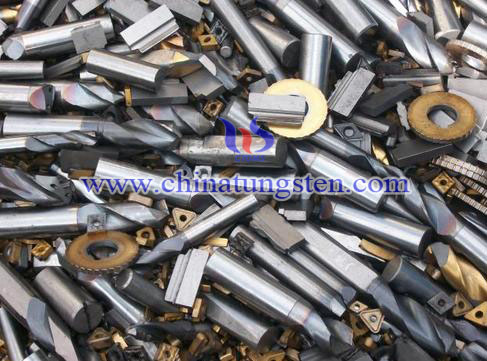
With tungsten massive mining and use level increasing, tungsten resources will be less and less, and the world tungsten industry will face a severe situation. Reasonable recovery of tungsten scraps can make up for the shortage of tungsten resources, which brings huge economic benefits. A method which will bring good economic benefit and promote the tungsten scraps recycling by the time preparing ammonium paratungstate (APT).
The specific preparation steps are:
1. Electric solution and magnetic separation: tungsten scraps separated in electrolyte solution to obtain tungsten carbide pellets, and then separator;
2. Decarburization: tungsten carbide set in the furnace for decarburization reaction to get tungsten oxide, control the temperature in 500~1600℃, keep the air circulation or inlet 0.5 ~ 1.0atm oxygen;
3. Dissolved in alkali solution: add tungsten oxide into NaOH solution which the mass concentration is 30%~50%, control the temperature at 130~180℃, stirred and soaked to obtain crude sodium tungstate;
4. Impurities removal: filter the sediment to remove bivalent ions of cobalt, nickel, iron and manganese, and also other impurities.
5. Dissolved in ammonia solution, and then crystallize: adding and stirring ammonia into tungsten organic phase, and then crystallize to obtain high purity ammonium paratungstate.
| APT Supplier: Chinatungsten Online ammonium-paratungstate.com |
Tel.: 86 592 5129696; Fax: 86 592 5129797;Email: |
| Tungsten News&Tungsten Prices, 3G Version: http://3g.chinatungsten.com | Molybdenum News & Molybdenum Price: http://news.molybdenum.com.cn |
Tungsten Carbide Ball Eccentric Arc Slot Grinding (2/2)
- Category: Tungsten Information
- Published on 02 February 2016
Before the grinding, according to the specifications of tungsten carbide ball to be ground, using the tool for forming the eccentric circular groove finishing, precision controlled within ± 0.01, which effectively ensure the good agreement between the ball and the grinding groove. Overall, the process can be divided into coarse grinding balls, semi-fine grinding, grinding, coarsely ground, semi-lapping, lapping, fine grind, polish eight processes. Before the beginning of each process must be thoroughly clean the device and select the appropriate size of the grinding tray. Generally, grinding compound is oil based boron carbide (BC), the granularity is about 180#, which effectively ensure the precision and efficiency of tungsten carbide ball, the sphericity is better than 0.6μm, the average rate of grinding can reach 20 μm/h.
In addition, after grinding to measure tungsten carbide ball, which the precision is related to the methods of measurement, the choice of measuring apparatus, the quality of ball surface, the fineness or cleanliness of ball surface, humiture of the conditions and many factors. After coarsely ground and semi-lapping should be used to measure microscopic micrometer, and take at least 20 points in the space above the whole sphere, ball measurement accuracy can be controlled within the 2μm. It should be used after lapping and polishing processes high-precision roundness measurement, measurement accuracy (0.04 + 6H / 1000μm, H refers to measuring height). Each batch of carbide spheres need to be tested with alcohol wipe, and left more than 4 hours in a constant temperature environment 25 ℃, the temperature and the sphere to be measured ambient temperature measurements can be carried out after leveling. Three cross-sectional scans every single space sphere has mutually perpendicular, each circular cross-section values are less than 1μm, sphericity this sphere can be considered qualified, sphericity value should be the average of measurements taken.
| Tungsten Carbide Supplier: Chinatungsten Online tungsten-carbide.com.cn |
Tel.: 86 592 5129696; Fax: 86 592 5129797;Email: |
| Tungsten News&Tungsten Prices, 3G Version: http://3g.chinatungsten.com | Molybdenum News & Molybdenum Price: http://news.molybdenum.com.cn |
Tungsten Carbide Ball Eccentric Arc Slot Grinding (1/2)
- Category: Tungsten Information
- Published on 02 February 2016
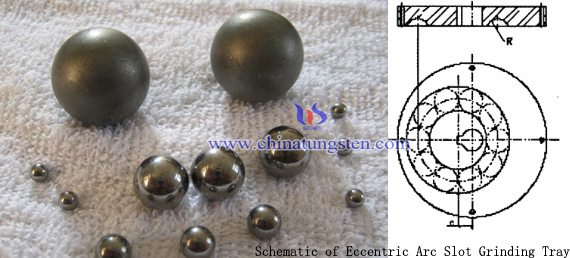
Compared with tungsten carbide ball V-slot grinding process, the rotating center of eccentric arc slot is deviated from the overall center. And the linear velocity of contacting points between tungsten carbide ball and grinding tray, it also adds a new rotary motion, which makes spin angle convert from relative invariant into the space amount, and the space included angle of axis of revolution become larger. The schematic of eccentric arc slot grinding tray is given as follow:
We can see from the figure, the eccentric circular groove grinding its way movement can be broken down into simply V-groove movement along the X axis and pure rolling. By adjusting the rotational speed, changing the relative velocity of the polishing, and it can achieve a wide range of spin angular variation, and to satisfy the carbide ball into round basic conditions that is 1. Equal probability: each dot on each of them to be processed carbide surface of the ball has the same probability of cutting; 2. Alternatives of grinding: in the process of grinding, the ball with large size should be ground more and the small size ground less or not; the margin of the longitudinal direction should be ground more and the margin of minor axis direction ground less or not.
| Tungsten Carbide Supplier: Chinatungsten Online tungsten-carbide.com.cn |
Tel.: 86 592 5129696; Fax: 86 592 5129797;Email: |
| Tungsten News&Tungsten Prices, 3G Version: http://3g.chinatungsten.com | Molybdenum News & Molybdenum Price: http://news.molybdenum.com.cn |
Inquiring Tungsten Trioxide Ceramic Sintering Phase
- Category: Tungsten Information
- Published on 02 February 2016
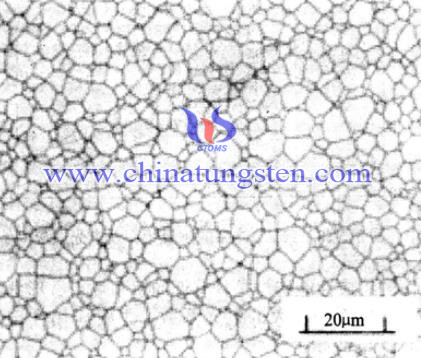
The study shows that the tungsten trioxide ceramics we prepared sintering at 1180 ℃, the relative density can reach about 94%. This means that the solid-phase sintering of both the early and mid-stage of our design before sintering process conducted post-sintering generally begins with relative density of the sintered body is greater than 90% at this stage, which is mainly a small pore exclusion and isolation grain growth. Pore radius of curvature by stress shrinking, with the closed pores increase in the gas pressure to achieve balance. Closed pores of the grain boundary portion fill the internal volume of the crystal through diffusion, this process is slow, and the densification is restricted. Late sintering, pores become isolated and grain boundaries communicate with each other form network, so it is only through the discharge pore volume of the grain boundary diffusion or to achieve grain growth through grain boundary migration.
The sintering is divided into three stages:
1: The initial stage of sintering. Embryo between powder particles in contact with each other through the mass transfer process, called sintering neck, and through their growth so that the embryo shrinkage;
2: Sintering the medium term. Grain growth begins at the beginning, and it is accompanied by a wide range of facets formed between the particles. In this case, the pores remain interconnected into continuous network, and the crystal interfaces between the particles remain isolated from one another. Most of the densification process and partially microstructure are produced in this phase;
3: Post-sintering. With the sintering process porosity becomes isolated, isolated pores eliminates the grain boundaries began at the grain boundary diffusion to form a continuous network. Post-sintering densification rate slowed down, and the development of microstructure such as grain growth is more rapid.
| Tungsten Oxide Supplier: Chinatungsten Online www.tungsten-oxide.com |
Tel.: 86 592 5129696; Fax: 86 592 5129797;Email: |
| Tungsten News & Prices, 3G Version: http://3g.chinatungsten.com | Molybdenum News & Molybdenum Price: http://news.molybdenum.com.cn |